

Business Operation · 2025
In this section23 topics
- Corporate Information4 items
- Dividend Policy2 items
- Major Shareholders1 item
- Business Strategies Overview7 items
- Material Changes & Developments2 items
- Use of Proceeds from Securities Offerings3 items
- Commitments Made in the Registration Statement1 item
- Group Operating-Structure Policy1 item
- Companies Where the Company Holds ≥10%1 item
- Shareholders with Potential Conflict of Interest1 item
- Relationships Among Major Shareholders1 item
- Shareholders' Agreement1 item
- Shareholding Diagram (Group Structure)2 items
- Income Structure4 items
- Product / Service Characteristics3 items
- Research & Development6 items
- Assets Used in the Business7 items
- Marketing Policy & Competition3 items
- Procurement of Products & Services8 items
- Nature of Business — Overview1 item
- Projects Under Construction1 item
- Debentures & Bills of Exchange1 item
- Convertible Securities1 item
Corporate Information
Company Name
Stone One Public Company Limited
Telephone
0-2391-9301
Website
https://www.stoneone.co.th
ir@stoneone.co.th
Dividend Policy
Dividend Policy
The Company has a dividend payment policy of not less than 50 percent of the net profit from the separate financial statements after deducting corporate income tax each year and the allocation of legal reserves.
However, the Company may stipulate a dividend payment rate lower than the aforementioned rate, depending on its operating results, financial position, liquidity, and the necessity of using working capital for business administration and expansion of the Company's operations. In the event that the Company still has accumulated losses, no dividend payment shall be made.
Historical Dividend Payments
| This Year | Last Year | 2 Years Ago | 3 Years Ago | 4 Years Ago | Metric | Description |
|---|---|---|---|---|---|---|
| 0.16 | 0.16 | 0.14 | 0.4 | 0.32 | Net profit per share (Baht : Share) | Net profit per share (baht : share) |
| 0.09 | 0.16 | 0 | 1 | 0.5 | Dividend per share (Baht : Share) | Dividend per share (baht : share) |
| 0 | 0 | 0 | 0 | 0 | Dividend stock ratio (Number of original shares: dividend shares) | Ratio of stock dividend payment (existing share : stock dividend) |
| 0 | 0 | 0 | 0 | 0 | Dividend share value per share (Baht : Share) | Value of stock dividend per share (baht : share) |
| 0.09 | 0.16 | 0 | 1 | 0.5 | Total dividend payment value (Baht : Share) | Total dividend payment (baht : share) |
| 50.33 | 91.97 | 0 | 112.33 | 65.46 | Dividend payout ratio to net profit (%) | Dividend payout ratio compared to net profit (%) |
Business Strategies Overview
Introduction
To establish a unified direction and goals for the "Group of Companies," the Company has clearly defined its Vision, Mission, and Organizational Targets in writing. Vision represents the ultimate aspiration the Company seeks to achieve. Mission comprises the duties and principles the Company upholds in its business operations. The main organizational target is the Company's primary plan for setting its operational direction, which necessitates the collective effort and dedication of all employees and executives.
Chairman's Message
The year 2025 was a challenging period for the Company, as it faced both domestic and international pressures. Domestically, changes in the political landscape directly affected budget planning and resulted in delays to various government projects pending disbursement under the 2025 annual fiscal budget. Externally, the Company was impacted by the slowdown in the global economy and trade, driven by prolonged uncertainty surrounding international trade policy, rising protectionist measures, the direction of major central banks’ monetary policies, and geopolitical conflicts. These factors, both directly and indirectly, affected the Company’s business operations.
The Board of Directors and management fully recognized these challenges and exercised prudent management, while adapting in a timely manner to changing circumstances.
During 2025, the Company was able to navigate these significant challenges smoothly. In particular, the investment in a new limestone quarry in Phetchaburi Province will serve as a new production source that is expected to generate income and support the Company’s sustainable growth in the future.
In terms of overall operating performance, the Company continued to generate revenue and profit as a result of effective internal management, production planning, product quality control, and consistent attention to customer needs. Nevertheless, the Company recorded total revenue of THB 411.81 million in 2025, representing a decrease of THB 44.78 million, or 9.81%, from 2024. The net profit margin increased by 0.21%. Despite the impact of economic volatility and the slowdown in customer orders during 2025, the Board of Directors and management made every effort to ensure that the Company maintained satisfactory profitability and continued to pay dividends to shareholders. This is in line with the Company’s core vision of becoming a green mining operator that grows sustainably while delivering sound returns and creating value for all stakeholders.
In addition, the Company remains committed to adapting its operations in line with sustainable development principles, reducing environmental impacts, and conducting business with social responsibility under its Environmental, Social and Governance (ESG) policy. This commitment is intended to ensure that STX grows sustainably and serves as a foundation for creating genuine value for society. The Company also continues to adhere to good corporate governance principles and fully supports anti-corruption efforts in order to ensure transparency in the operations of the Company and its subsidiaries, in accordance with good governance practices, and to foster sustainable growth for shareholders.
Over the past year, the Company encountered a wide range of challenges. However, through the collective efforts of all parties, STX was able to overcome these obstacles smoothly. On behalf of the Board of Directors and management, I would like to express my sincere appreciation to our shareholders, employees, customers, and business partners for their continued trust and unwavering support. The Company remains committed to conducting its business under the principles of good corporate governance, while creating sustainable value with due regard for social and environmental responsibility. Going forward, the Company will continue to focus on business development and sustainable growth in order to strengthen its leadership in the industry, contribute to society, and maintain financial stability and sound profitability.
-Parametee Vimolsiri-
Dr. Parametee Vimolsiri
Chairman of the Board
Stone One Public Company Limited
Message from the Chief Executive Officer
Global economic volatility over the past year affected many regions, including the United States, Europe, the Middle East, Asia, and Thailand. Thailand was impacted by inflationary pressures, volatile interest rates, the appreciation of the Thai Baht, increases in U.S. import tariffs, and conflicts arising from wars in neighboring countries. These factors inevitably affected the growth of the construction materials industry. Nevertheless, with over 30 years of experience in the quarrying industry, the Company has continued to move forward with strength and resilience. The Company remains committed to producing quality products and delivering reliable services, while maintaining responsibility toward its trading partners and stakeholders. As a result, in 2025, the Company was able to maintain stable operations and sound profitability.
Looking ahead to 2026, the construction contracting business is expected to see slight growth in the public sector, although it may continue to face pressure from fiscal budget constraints and political uncertainty. At the same time, progress is being made in the construction sector, particularly with regard to mega projects, as new mega project tenders are expected to commence in 2026. This is likely to gradually channel investment into public sector construction. However, private sector construction may continue to contract in line with weakness in the residential property market and the low growth outlook for the Thai economy. In addition, construction material prices remain high compared with historical levels, requiring the Company to adjust its pricing measures in order to preserve market share and remain competitive.
For the 12-month period ended December 31, 2025, the Company reported total assets of THB 1,115.80 million, an increase of THB 164.45 million, or 17.29%, from December 31, 2024. This was mainly attributable to an increase in intangible assets resulting from the recognition of the fair value of the new mining concession acquired through the purchase of shares in Boonthavorn Mining Co., Ltd., amounting to THB 215.16 million. Total liabilities amounted to THB 229.21 million, an increase of THB 144.28 million, or 169.90%, primarily due to borrowings from financial institutions to finance the construction of buildings and the purchase of machinery for the new quarry in Phetchaburi Province, which is intended to support stable long-term growth. Nevertheless, the Company continued to maintain a low debt-to-equity ratio, which stood at 0.26 at the end of 2025, reflecting a strong financial position and readiness to support future growth.
In 2025, the Company generated total revenue of THB 411.81 million, a decrease of 9.81%, and recorded net profit of THB 51.87 million, which was close to the previous year’s level. The decline in revenue was mainly attributable to delays in EEC projects from the original schedule, which reduced demand for industrial stone, while at the same time increased stone supply in the market intensified competition. However, management remains confident that, given the Company’s long-established business operations, quality-based production foundation, and strong customer base, the Company will continue to generate stable revenue and sound profit in the future.
In addition to managing the business for long-term earnings growth, the Company places importance on maximizing the efficient use of available resources. This includes inventory management, setting production efficiency targets, and adopting new innovations in the production process to help reduce costs and improve production cost management. This remains one of the Company’s key objectives in ensuring that its limited resources are utilized to their fullest benefit over the long term.
In 2025, the Company also placed strong emphasis on sustainable development. It implemented projects aimed at reducing environmental impacts, conducted business in accordance with its good corporate governance policy, upheld social responsibility, and complied with its anti-corruption policy and business ethics guidelines. These actions were undertaken to strengthen confidence among all stakeholder groups and to reinforce the Company’s commitment to social and environmental responsibility through sound governance practices.
On behalf of the Board of Directors, I would like to express my sincere gratitude to our shareholders, customers, and business partners for their continued trust and unwavering support. The Company deeply appreciates the confidence that all of you have placed in us, which has been an important factor in the Company’s continued growth and success.
The Board of Directors would also like to extend its heartfelt thanks to the management team and all employees for their dedication and commitment in performing their duties to the fullest extent. The Company sincerely hopes that in 2026, the management team and employees will continue to lead the Company toward success in developing the new quarry and delivering strong returns to all stakeholders.
-Krittanan Pingclasai-
Mr. Krittanan Pingclasai
Chief Executive Officer
Stone One Public Company Limited
Vision
To be a leading company in the business of manufacturing and distributing industrial stones for construction, with raw material sources across all regions, operating efficiently, transparently, and responsibly towards society and the environment.
Objectives
The Board of Directors has established the primary objectives and goals for the organization's business operations, enabling it to conduct business while simultaneously prioritizing social, environmental, and sustainability aspects, and undertaking activities beneficial to the organization and all stakeholders, including customers, business partners, employees, and the company's shareholders, with a continuous focus on management under good corporate governance.
Goals
Based on the company's vision and mission, business objectives have been set, including the expansion of raw material sources and future production to extend the business across all regions. This aims to generate continuous profits for shareholders, adhering to principles of sustainable development and social and environmental responsibility. The company has consistently received the Corporate Social Responsibility for Mineral Industry Operators (CSR-DPIM) award and the Green Mining award, reflecting its commitment to creating sustainable value for all stakeholders.
Long-term business objectives (3-5 years)
Sustainably expand growth in the company's core business, leveraging current revenue from existing quarries and new quarry sources where the company has expanded investment and will begin generating revenue in 2026. These new sources will be significant primary revenue streams in the future. The company will manage these operations to ensure profitability and expand its customer base in line with the new production sites, thereby increasing the company's future revenue and profits. Furthermore, for existing customers, the company remains focused on producing high-quality products and services that meet customer needs and maintaining strong, continuous relationships.
The company aims to expand its revenue base into other businesses that are related to or associated with the use of the company's raw materials, products, or services, which can generate income and provide a worthwhile return on investment. This is to create opportunities for revenue generation and serve as a contingency plan for changes in economic conditions, geopolitics, and overall government policy.
Expanding production capacity for continuous growth while managing inventory at an appropriate level to prevent overstocking beyond consumer demand. This also includes improving production plans for increased efficiency, reducing the storage of slow-moving inventory, and focusing on producing goods that meet market demands. The company has planned and reviewed its sales and production plans to align with economic conditions and changing consumer values.
Production quality control remains a key factor for the company in manufacturing products and services for customers, ensuring that products meet standards and customer-specified qualifications. The company aims to develop production processes to reduce reliance on personnel by adopting modern machinery with higher operational safety. Furthermore, the company aims to continuously research and develop products to foster new innovations that meet the needs of consumers in new market segments.
Regarding internal operational efficiency goals, the company aims to improve working processes for greater efficiency. There is a plan for investment and financial management to prepare for future investments and business expansion. Furthermore, the company aims to develop the potential of its executives, employees, and all relevant stakeholders to lead the organization towards strong and sustainable business growth. This is achieved by adhering to the company's code of ethics and good corporate governance principles, and by considering human rights and labor principles, to guide the organization towards sustainable success, as the company's personnel are considered vital resources for its operations.
Regarding the organization's sustainability goals, the company is committed to developing products that meet the requirement of the economy, society, and environment, including stakeholders. The company continues to prioritize responsibility for its products and production processes, not limited to compliance with regulations and laws, but also focusing on reducing potential impacts on communities, society, and the environment. This includes fostering coexistence between the company and communities, respecting the rights of stakeholders, and committing to sustainable community development. Additionally, the company has a policy to support and assist society and communities, ensuring that the business and communities grow together sustainably.
Business Strategies
The company has a long-term goal of becoming a "Sustainable Green Mining producer that grows sustainably while caring for the environment and community." Therefore, the company has established the following operational strategies:
Focusing on maximizing the production capacity of the Chom Bueng quarry by increasing production volume during the first half of the year to accommodate early-season purchases, while also ensuring production readiness aligns with business plans and maintains flexibility, thereby strengthening revenue stability and future growth.
The company plans to drive an increase in its sales, including revenue from the Chom Bueng quarry in Ratchaburi Province and the Khao Yoi quarry in Phetchaburi Province, which is currently under factory construction. The construction plan remains on schedule. Once the Khao Yoi quarry is completed, it will generate another long-term revenue stream for the company.
In terms of product manufacturing, the company continuously focuses on producing profitable products, such as Bigrock, 20 mm stone, and 6 mm stone, as well as new products like dolomite, which the company is ready to develop and expand its market to products that can create added value for the company.
In terms of marketing, the company builds awareness and recognition of its products and services among customers by managing sufficient product stock and responding to customer needs, ensuring smooth execution of production and sales plans.
Driving continuous development and innovation to enhance existing products to better meet customer needs and to create new innovative products that align with consumer demands in new, larger, and more diverse market segments.
Continuously focusing on cost and expense reduction, the company prioritizes efficient management of production costs to reflect its profitability and to build stability and sustainability in long-term operations.
Other Information
| Name | Description | ||||||||||||||||||
|---|---|---|---|---|---|---|---|---|---|---|---|---|---|---|---|---|---|---|---|
| Mission |
Organizational Values:
| ||||||||||||||||||
Material Changes & Developments
Introduction
Stone One Public Company Limited ("the Company" or "STX") was established in 1996 under the name Pioneer Aggregates (Thailand) Company Limited, with an initial registered capital of 35,991,000 Baht, at a par value of 100.00 Baht per share. The Company operates a quarry business, producing and distributing industrial stone products, specifically granite, for use in construction and other related industries, including sand pits, and the business of producing and distributing ready-mixed concrete.
On June 1, 2001, the Company changed its name from Pioneer Aggregates (Thailand) Company Limited to Hanson Aggregates (Thailand) Company Limited due to a change in shareholder structure to the Hanson Group. The quarry and sand pit businesses were separated from the ready-mixed concrete production and distribution business. Hanson Aggregates (Thailand) Company Limited operated the quarry and sand pit businesses, and a new company was established to operate the ready-mixed concrete production and distribution business.
In 2004, the Company changed its name from Hanson Aggregates (Thailand) Company Limited to Boral Aggregates (Thailand) Company Limited, continuing its quarry and sand pit businesses. There was a change in the shareholder group, with the former shareholder group, Hanson Group, selling all its shares in the Company to the Boral Group, Australia, which is a multinational construction materials business group. The Company's shareholders included Boral Concrete (Thailand) Company Limited, a legal entity registered in Thailand, and Boral (International) Company Limited (Boral Australia is a company listed on the Australian Stock Exchange, operating in the sale of construction materials and a leader in the aggregates business in Australia).
On December 6, 2012, Boral Concrete (Thailand) Company Limited, Boral International Pty Limited, and M.J.I. (Thailand) Company Limited sold 99.99% of the Company's paid-up registered capital to Mr. Jrarat Pingclasai and Mr. Siam Watcharaprecha, in proportions of 60.00% and 40.00% of the Company's paid-up registered capital, respectively, following mutually agreed share transfer procedures.
As the Company focuses on operating quarry and sand pit businesses as its core activities, it separated the ready-mixed concrete production and distribution business from its core operations. This was done by selling the ready-mixed concrete business, which included factory operating licenses, transfer of rights under land lease agreements, transfer of land where the factory was located, and other assets required for producing and distributing ready-mixed concrete. The Company sold or transferred all assets and liabilities related to the ready-mixed concrete business to an unrelated entity on December 14, 2012. Therefore, from December 14, 2012, onwards, the Company's business operations consist solely of quarry and sand pit businesses.
Subsequently, in 2018, the Company restructured its shareholding to mitigate conflicts of interest in businesses competing with the Company. This involved the sale of 40% of the shares held by Mr. Siam Watcharaprecha's group to Mr. Jrarat Pingclasai. Mr. Jrarat Pingclasai then sold these acquired shares to Mr. Ikuo Ano's group, which sought to invest in the Company's stone production and distribution business.
Following the business and shareholding restructuring in 2018, the Company operates under the management of two major shareholder groups: the Pingclasai family group and the Ano family group, along with a management team specialized in developing quality stone mines and serving as key raw material sources in the construction industry.
Currently, the Company has three subsidiaries:
Rachaburi Enterprise Company Limited ("subsidiary" or "RBE") operates a quarry business, producing and distributing industrial stone products, specifically limestone, for use in construction. Subsequently, in 2021, the subsidiary expanded its production to include the manufacturing and distribution of dolomite, a product that significantly adds value to the Company.
Boonthavorn Mining Company Limited ("subsidiary" or "BTV") operates a quarry business, producing and distributing industrial stone products, specifically limestone, for use in construction. The Company invested in BTV in May 2025. Currently, the production plant is under construction, and the quarry area is being developed, with sales expected to commence in 2026.
Currently, the Company and its subsidiaries have an operational structure as shown in Diagram 1.
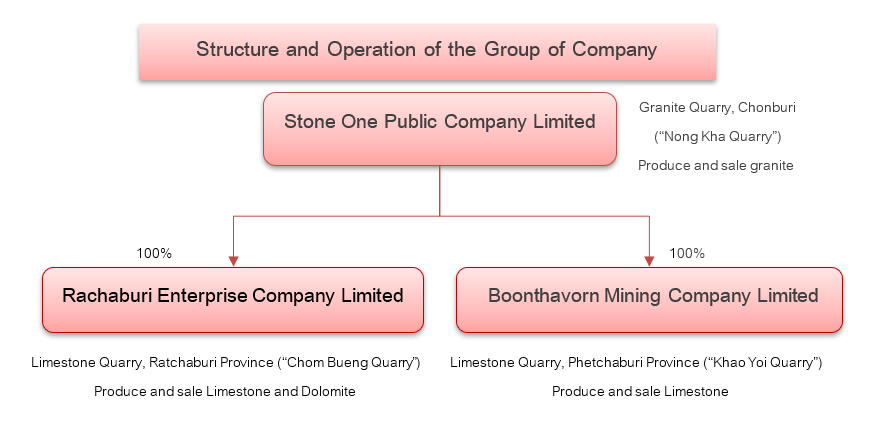
Diagram 1 shows the operational structure of the group of companies.
As of December 31, 2025, the Company has a registered and paid-up capital of 307,134,600.00 Baht, divided into 307,134,600 ordinary shares with a par value of 1.00 Baht per share, each carrying one voting right (One Share One Vote).
In 2025, the Company and its subsidiaries operate three stone quarry, comprising:
1.Nong Kha Quarry (produces and distributes granite) operated by the Company.
Nong Kha Quarry: Located in Bang Phra Subdistrict, Si Racha District, Chonburi Province.
Remaining reserves as of December 31, 2025, amount to -0- million tons.
2. Chom Bueng Quarry (produces and distributes limestone and dolomite) operated by subsidiary RBE.
Chom Bueng Quarry: Located in the connecting area of Rang Bua Subdistrict and Chom Bueng Subdistrict, Chom Bueng District, Ratchaburi Province.
The remaining reserves of the limestone quarry as of December 31, 2025, amount to 7.76 million tons.
The remaining reserves of dolomite as of December 31, 2025, amount to 0.99 million tons. The actual utilization volume depends on the production plan at the quarry face.
3.Khao Yoi Quarry (produces and distributes limestone) operated by subsidiary BTV.
Khao Yoi Quarry: Located in Nong Chumphon Nuea Subdistrict, Khao Yoi District, Phetchaburi Province.
The remaining reserves of the limestone quarry as of December 31, 2025, amount to 24.21 million tons. The actual utilization volume depends on the production plan at the quarry face.
The granite quarry, limestone quarry, and dolomite production plant are shown in Diagram 2 as follows:
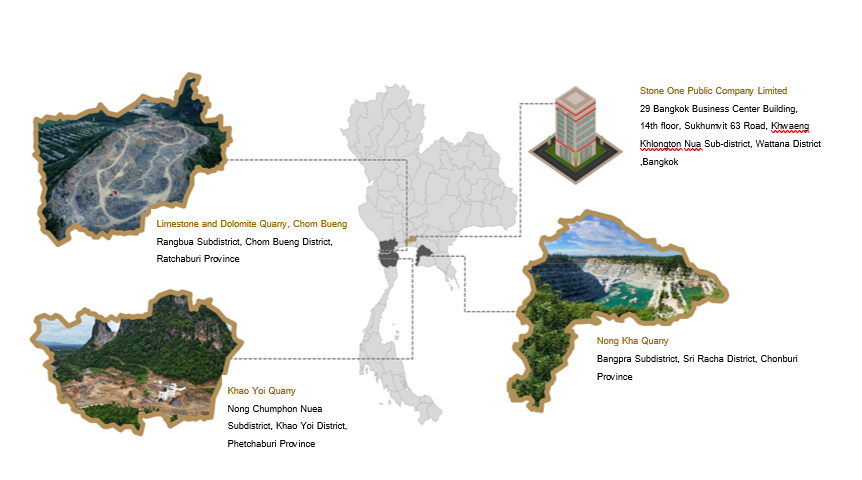
Diagram 2: Location of the head office and the Company's three stone quarries
For future plans, the Company aims to expand its raw material sources and future production to extend its business coverage across all regions. This will be achieved by investing in existing quarry businesses or developing new quarries in suitable locations. Each quarry must not overlap with others, maintaining a distance of more than 150 kilometers around the quarry area to reduce internal competition. This is because the quarry business is distance-competitive, as transportation costs are a significant burden for customers. Therefore, locations beyond this distance would result in excessively high transportation costs. However, the distance between the locations of quarries the Company plans to expand to may be less if market demand is sufficiently high, eliminating the nature of self-competition.
Environmentally friendly mining is practiced with measures for quarry site rehabilitation during and after the mining process. This includes designating areas around the quarry perimeter as green spaces, preparing suitable areas for tree growth with biodiverse local plant species to ensure the ecosystem closely resembles the surrounding areas. Additionally, good relationships are fostered with communities around the quarry by creating employment, providing career opportunities, and caring for the communities in the quarry's vicinity to grow together with the Company.
Material Changes & Developments
| Year | Description |
|---|---|
| 2,025 |
|
| 2,024 |
|
| 2,020 |
|
| 2,021 |
|
| 2,022 |
|
| 2,023 |
|
Use of Proceeds from Securities Offerings
Introduction
As of December 31, 2025, the Company has utilized the capital increase received from the initial public offering (IPO) of 65,000,000 shares at a price of 3.00 Baht per share. The Company received a total of 176.32 million Baht from the capital increase (after deducting expenses related to the share offering). The details are as follows:
Is There Money Raised from a Securities Offering Still to Report On?
Yes
Offerings
| Type of Securities | Amount Raised Given As | Amount Raised (Million Baht) | Uses of the Money | Used as Declared? |
|---|---|---|---|---|
| Equity Instruments | 2873 | 176.32 | 2025-12 · Objective: 1. For investment within the quarrying and mineral sector or the acquisition of quarries and mineral reserves or the construction of factory building, including investment in related machinery and equipment. · Period type: 2871 · Start period: 2025-12 · Spent amount type: 2873 · Start spent amount: 150.0 · Expected amount type: 2873 · Start expected amount range: 150.0 · 2025-12 · Objective: 2. To use for working capital for business operations. · Period type: 2870 · Start period: 2024-06 · Spent amount type: 2873 · Start spent amount: 26.32 · Expected amount type: 2873 · Start expected amount range: 26.32 | Y |
Commitments Made in the Registration Statement
Are There Commitments or Conditions from an Offering or Listing?
No
Group Operating-Structure Policy
Description
The company operates under the management of two major shareholder groups: the Pingclasai family group and Mr. Ikuo Ano, along with a management team specializing in the development of quality stone quarries and serving as a crucial primary raw material source for the construction industry. The company has two subsidiaries: (1) Rachaburi Enterprise Company Limited ("RBE"), which operates a limestone quarry for construction purposes, including the production and distribution of Dolomite products, and (2) Boonthavorn Mining Company Limited ("BTV"), which operates a stone quarry business. BTV will produce and distribute industrial limestone for construction. The company invested in BTV in May 2025. Currently, the production plant is under construction, and sales are expected to commence in 2026.
Companies Where the Company Holds ≥10%
Companies (≥10% Holding)
| Company Name | Address | Province | Zip Code | Telephone | Fax | Business Type | Security Type | Shares | Paid-up Shares |
|---|---|---|---|---|---|---|---|---|---|
| Rachaburi Enterprise Company Limited | 29 Bangkok Business Center Building, 14th Floor, Sukhumvit 63 Road, Khlong Tan Nuea Sub-district, Watthana District | Bangkok | 10110 | 66 (2) 391-9301 | 66 (2) 391-9302 | Production and distribution of limestone and dolomite. | Common shares | 2,100,000 | 2,100,000 |
| Boonthavorn Mining Company Limited | 29 Bangkok Business Center Building, 14th Floor, Sukhumvit 63 Road, Khlong Tan Nuea Sub-district, Watthana District | Bangkok | 10110 | 66 (2) 391-9301 | 66 (2) 391-9302 | Production and distribution of limestone | Common shares | 120,000 | 120,000 |
Income Structure
Introduction
The company's revenue structure can be categorized into 3 groups:
Revenue from mining business consists of revenue from the sale of products obtained from mining, including transportation services, which involves selling products along with delivery to customers.
Revenue from transportation business consists solely of revenue from transportation services, excluding transportation service fees for product sales from the mining business.
Other income includes other income from the mining business, which arises from the sale of by-products generated from mining, and other income comprising interest income, gain on disposal of assets, bad debt recovered, income from scrap sales, electricity discounts, and other adjustments, etc.
Total revenue for the year ended December 31, 2023, 2024, and 2025 were 371.28 million baht, 456.60 million baht, and 411.81 million baht, respectively, categorized by revenue type as follows:
Product / Service Income
| Category | Description | This Year | This Year % | Last Year | Last Year % | 2 Years Ago | 2 Years Ago % |
|---|---|---|---|---|---|---|---|
| Total revenue from operations | Total revenue from operations | 411,812.85 | 100 | 456,595.81 | 100 | 371,280.81 | 100 |
| Revenue from sales and services from mining business | 374,805.23 | 91.01 | 406,661.22 | 89.06 | 315,934.71 | 85.09 | |
| Revenue from transportation services | 0 | 0 | 0 | 0 | 380.31 | 0.1 | |
| Other income from mining operations | 27,997.11 | 6.8 | 37,162.17 | 8.14 | 36,966.92 | 9.96 | |
| Other | Other | 9,010.51 | 2.19 | 12,772.43 | 2.8 | 17,998.88 | 4.85 |
Export Income
| Category | Description | This Year | This Year % | Last Year | Last Year % | 2 Years Ago | 2 Years Ago % |
|---|---|---|---|---|---|---|---|
| Total revenue | Total revenue from operations | 411,812.85 | 100 | 456,595.81 | 100 | 371,280.81 | 100 |
| Domestic | Domestic | 411,812.85 | 100 | 456,595.81 | 100 | 371,280.81 | 100 |
| International | International | 0 | 0 | 0 | 0 | 0 | 0 |
Other Income
| Operating Other Income | Non-Operating Other Income | Share of Profit |
|---|---|---|
| 1710 · As of year: 37007.63 · Description: Total other income · As of yesteryear: 49934.6 · As of year before yesteryear: 54965.8 · 1711 · As of year: 27997.11 · Description: Other income from operations · As of yesteryear: 37162.17 · As of year before yesteryear: 36966.92 · 27997.11 · Description: Other income from mining operations · As of yesteryear: 37162.17 · As of year before yesteryear: 36966.92 · 9010.52 · Description: Other income · As of yesteryear: 12772.43 · As of year before yesteryear: 17998.88 | 1712 · As of year: 9010.52 · Description: Other income not from operations · As of yesteryear: 12772.43 · As of year before yesteryear: 17998.88 | 1713 · As of year: 0.0 · Description: Share of profit · As of yesteryear: 0.0 · As of year before yesteryear: 0.0 |
Product / Service Characteristics
Introduction
The company's products include industrial stone products such as granite and limestone for the construction industry, and dolomite mineral, as well as transportation services. Details of each product and service type are as follows:
Business Type
3114
Business Groups
| Business Group | Description |
|---|---|
| (1) Industrial stone products: granite and limestone | (1.1) Characteristics and Uses of Industrial Stone The company and its subsidiaries produce two types of industrial stones for construction: granite and limestone. Both types of stone are generally interchangeable, depending on the available stone sources in each locality.
(1.2) Company's Stone Product Types
Industrial Stone Products for Construction Main Products
Semi-finished Products
Other Products and By-products
|
| (2) Dolomite Mineral Products | (2.1) Characteristics and Uses of Dolomite The Company and its subsidiaries produce dolomite, which is a new product that can be applied to various other uses as follows:
(2.2) Company's Mineral Product Types Dolomite Mineral Products
|
| (3) Transportation Services | The company provides transportation services to clients through efficient management and operations, ensuring that goods are delivered to their destination accurately, completely, on time, and securely. |
Research & Development
Has R&D Policy (Y/N)
No
R&D Cost — Description
The company is continuously engaged in the research and development of innovations, new products, and offerings, including the improvement of environmentally responsible production plans and the enhancement of operational safety. This is to meet consumer demands and promote operational efficiency.
R&D Cost — Label
Research and development (R&D) expenses over the past 3 years (Million Baht)
R&D Cost — This Year
0.0
R&D Cost — Last Year
0.0
R&D Cost — 2 Years Ago
0.0
Assets Used in the Business
Introduction
The company's head office is located at 29 Bangkok Business Center Building, 14th Floor, Sukhumvit 63 Road, Khlong Tan Nuea Sub-district, Watthana District, Bangkok 10110. As of December 31, 2025, the Company and its subsidiaries have a total of 3 branches, namely: (1) Nong Kha Branch, which is the location of Nong Kha Granite Quarry, Bang Phra District, Chonburi Province; (2) Chom Bueng Branch, which is the location of Chom Bueng Quarry and Dolomite Processing Plant, Chom Bueng District, Ratchaburi Province; and (3) Khao Yoi Branch, which is the location of Khao Yoi Limestone Quarry, Khao Yoi District, Phetchaburi Province.
Permanent Assets — Description
As of December 31, 2025, the net value of major assets used in the operations of the Company and its subsidiaries, as presented in the Company's consolidated financial statements, amounted to Baht 452.49 million, or 40.55 percent of total assets, with details as follows:
Major fixed assets, comprising land and land improvements, are stated at revalued amounts. Buildings, machinery and equipment, furniture and office equipment, and vehicles are stated at cost less accumulated depreciation and impairment losses (if any). The Company initially records land at cost on the date of acquisition. Subsequently, the Company arranges for independent appraisers to revalue the land and records such assets at their revalued amounts. The Group conducts periodic revaluations of land to ensure that the carrying amount reflects the true value at fair value.
Right-of-use assets are amortized by using the straight-line method over the shorter of the asset's useful life and the lease term. If the Company is reasonably certain to exercise a purchase option, the right-of-use assets are amortized over the useful life of the underlying asset.
Permanent Assets — Appraisal
| Asset | Ownership | Obligation | Appraisal Value |
|---|---|---|---|
| Land and Land Improvement | Company and its subsidiaries | Partial obligations. | 112.43 |
| Quarry land | Company and its subsidiaries | None | 21.94 |
| Buildings and building Improvement | Company and its subsidiaries | None | 47.68 |
| Machinery and Equipment | Company and its subsidiaries | Partial obligations. | 128.88 |
| Funiture and office equipment | Company and its subsidiaries | None | 1.06 |
| Vehicle | Company and its subsidiaries | None | 2.7 |
| Construction in progress | Company and its subsidiaries | None | 69.08 |
| Right-of-use assets | Company and its subsidiaries | Partial obligations. | 68.71 |
| Total | Company and its subsidiaries | Partial obligations. | 452.49 |
Intangible Assets — Description
The Company possesses intangible assets used in the company's business, including mining concessions, computer software, trademarks, and deferred exploration expenditure. Mining concessions are recorded at cost and amortized based on the quantity of product relative to the estimated mineral reserves. Assets with finite useful lives are measured at cost less accumulated amortization and accumulated impairment losses. Amortization is calculated using the straight-line method over the estimated useful lives of the assets as follows: Trademarks 10 years, and computer software 3 to 10 years.
Intangible Assets — Appraisal
| Asset | Type | Type (if Other) | Appraisal Value |
|---|---|---|---|
| 1. Concession | Concession | 220.38 | |
| 2. Computer software | Software | 1.52 | |
| 3. Trademark | Trademark | 6.18 | |
| 4. Deferred exploration expenditure | Others | Amortized expenses | 2.48 |
| 5. Assets in progress | Others | Assets in Progress | 0.15 |
| Total | Others | Total Value | 224.54 |
Has Subsidiaries Investment Policy (Y/N)
Yes
Subsidiaries Investment Policy — Description
The Company has set operational goals, primarily focusing on investing in industrial rock quarry businesses for construction. It will consider investing in subsidiaries or associated companies engaged in related businesses, or those that generate benefits and support the Company's core business operations. These businesses must have potential and be able to enhance the Company's stability and long-term performance.
In considering such investments, the Company will prepare feasibility studies and assess the reasonableness of each investment project for submission and approval by the Board of Directors' meeting and/or the shareholders' meeting, as the case may be. The Company and its subsidiaries shall comply with the criteria of the Securities and Exchange Commission and/or the Stock Exchange of Thailand, and apply the criteria related to disclosure and the aforementioned transactions in the same manner as the Company's own criteria. Furthermore, it must oversee the collection and recording of accounting data for subsidiaries to enable the Company to inspect and consolidate the data to prepare consolidated financial statements in a timely manner as required by the Stock Exchange of Thailand, and must also monitor and ensure that directors and executives of subsidiaries and associated companies perform their duties and responsibilities as prescribed by law.
Marketing Policy & Competition
Reporting Mode
3117
Marketing Policy (Overall)
(1) Competitive Strategy
(1.1) Sales Pricing
The selling prices of the company's products vary by quarry, referencing the market prices of local quarry operators. Nong Kha quarry references the selling prices of the Chonburi Quarry Association, Chom Bueng quarry references the selling prices of the Khao Sam Ngam Quarry Group Association, and Khao Yoi quarry references the selling prices of neighboring quarry operators. Furthermore, selling prices are also subject to market demand and supply, which the company will adjust according to its own criteria.
For dolomite, pricing is primarily determined through negotiation between the buyer and seller, as the product's properties are highly specific to each customer's requirements. Therefore, there are no reference prices from local operator associations, unlike industrial stone for construction, and pricing depends on market demand and supply.
The company has set selling prices for each quarry, namely Nong Kha Granite Quarry and Chom Bueng Limestone and Dolomite Quarry, with prices varying. The pricing criteria consist of two parts as follows:
1) Determined by the quality, type of stone (granite or limestone, including dolomite), and size of the stone, which can be benchmarked against standard/market prices set by local quarry associations (if any).
2) Transportation costs (if any), calculated based on the transportation distance from each quarry to the delivery point.
(1.2) After-Sales Service
The company provides after-sales service to customers by monitoring the quality of delivered products. In case of product quality not meet standards, the company will compensate customers by offering discounts or delivering new products at no additional charge, which will be considered on a case-by-case basis. This also includes analyzing customer order data to track order volumes for ensuring sufficient product availability to meet customer demand. Furthermore, the company conducts customer satisfaction surveys every 6 months to continuously develop and improve product quality and services.
(2) Customer Characteristics and Target Customer Groups
Industrial stone products for construction: Due to the nature of the product, it is a specialized item for construction business customers, primarily using 20 mm stone. Therefore, the company divides its customer groups into two categories as follows:
1. Large corporate groups that are ready-mixed concrete business operators and construction contracting business groups, which are the company's main customer groups with whom long-standing business relationships have been maintained.
2. Local retail customers located near the quarries within a radius of approximately 150 kilometers. If the distance exceeds 150 kilometers, the increased transportation costs would raise the customer's overall cost of purchasing stone, leading customers to choose to order from closer quarries instead. This is because the general characteristics and production of stone typically result in very similar quality, allowing for complete interchangeability, except for specialized stone applications requiring specific quality measurements, such as racetrack construction.
The company manages the proportion of large and small customers appropriately. Large customers are a group that can generate high sales volumes and ensure consistent product delivery. Transactions with them are typically based on 1-year long-term sales contracts with fixed prices as specified in the agreement. This customer group provides consistent revenue and timely payments for goods and services. Additionally, the company aims to expand its base to small customers who have a continuous purchasing history with the company, with selling prices based on the company's announced price list, which yields a higher profit margin than the large customer group.
Dolomite products: The company has divided customers for this product group into two categories:
1) Dolomite Lump
Currently, the company produces three sizes: 0-30 mm, 30-60 mm, and 60-100 mm The company produces dolomite according to its intended use and customer requirements. For example, 0-30 mm dolomite is sold to customers in the cement manufacturing industry, road construction, and customers who use it as raw material for grinding and resale. 30-60 mm dolomite is sold to customers for power plant flooring, insulation panels, and general construction. 60-100 mm dolomite is sold to customers in the lime kiln industry for resale to steel manufacturing industry customers, for use in furnaces to enhance furnace efficiency.
2) Dolomite Powder
The company has further developed dolomite from its original lump form into powder form, which the company can produce in sizes ranging from 0 to 325 Mesh. This product commands a higher price than lump dolomite. Currently, the company produces and sells 100 Mesh dolomite to construction industry customers for use as an ingredient in plaster. In Q2 2023, 15-60 Mesh dolomite was sold to glass and mirror manufacturing customers for use as an ingredient to enhance the strength of glass and mirrors to meet standards.
Industry & Competition (Overall)
Industry Competition in the Past Year
Industry Overview
The Company operates a quarry business for stone and dolomite minerals. It produces and distributes industrial stone products, including granite and limestone, for use in construction, as well as dolomite for applications in the cement industry, glass and mirror manufacturing, agriculture, and livestock. The Company also provides logistics services, offering comprehensive transportation solutions to customers. The Company’s business growth aligns with the overall economic conditions of the country, including the expansion of the construction sector and investments from both public and private sectors, as detailed below.
1) Overview of the Thai Economy
Current Economic Conditions in Thailand
Thailand’s economy in Q4 2025 expanded by 2.5%, accelerating from 1.2% in Q3 2025. On a seasonally adjusted basis, the economy grew by 1.9% quarter-on-quarter (QoQ_SA). For the full year 2025, the Thai economy expanded by 2.4%, compared to 2.9% in 2024.The details as follow:
Expenditure Side:
Private consumption expenditure expanded by 3.3 percent, accelerating from 2.5 percent in the previous quarter. This represented an expansion across all categories. Growth in expenditure on durable goods aligned with the front-loading of vehicle purchases prior to the expiration of the Electric Vehicle Support Measure, Phase 1 (EV 3.0), while spending on non-durable and semi-durable goods was driven by government measures. By category, expenditure on servicesincreased by 3.0 percent, higher than a 2.0 percent rise in the previous quarter, attributed to the continued growth in spending on healthcare and transport services, which rose by 2.1 percent and 1.7 percent, respectively. Expenditure on durable goodsrose by 12.2 percent, surging from a 6.0 percent expansion in the previous quarter, following vehicle purchases, which expanded at a high rate of 26.4 percent, accelerating from 13.9 percent in the previous quarter. Expenditure on semi-durable goodsexpanded by 2.6 percent, increasing from 0.8 percent in the previous quarter, due to accelerated spending on clothing and footwear, which increased by 3.4 percent. Additionally, spending on furniture and household equipment rose by 1.7 percent, marking the first increase in four quarters. Expenditure on non-durable goods grew by 2.6 percent, continuing from a 2.9 percent increase in the previous quarter, mainly driven bygrowth in food and beverages spending. However, spending on electricity, gasoline, and other fuels declined by 3.2 percent.Overall, the growth of private consumption expenditure in this quarter was consistent with the Consumer Confidence Index (CCI), which increased to 45.9 from 44.7 in the previous quarter.
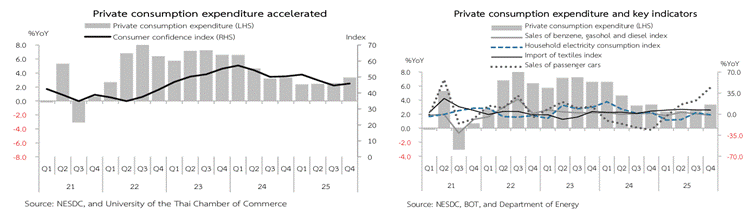
Source: Macroeconomic Strategy and Planning Division
Investment in construction: rose for the first time in seven quarters, increasing by 4.8 percent, compared to a 1.0 percent decline in the previous quarter. The growth was consistent with the expansion in residential construction, which grew by 4.4 percent, improving from a 3.2 percent reduction previously, following an increase in construction area permits. Meanwhile, non-residential construction grew by 6.5 percent, accelerating from 1.7 percent in the previous quarter. This was largely attributed to a surge in industrial factory construction, which grew by 12.2 percent, up from 6.9 percent previously. Moreover, commercial building construction expanded by 4.8 percent, rebounding from a 4.7 percent decrease in the previous quarter.
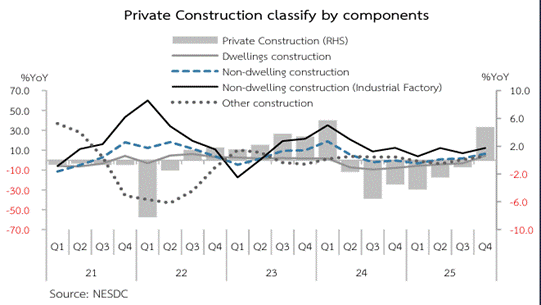
Source: Macroeconomic Strategy and Planning Division
Production Side:
The construction sector returned to expansion of 11.2 percent, compared to a decrease of 4.5 percent in the previous quarter.This was driven by public construction returning to expand at a high rate, and private construction returning to expansion for the first time in seven quarters. In this quarter,
(1) public constructionexpanded at a high rate of 15.6 percent, compared to a decrease of 6.7 percent in the previous quarter. Government constructionexpanded at a high rate of 24.1 percent, compared to a decrease of 10.7 percent in the previous quarter. This was in line with the increase in construction of major projects such as the national highway network construction project (Motorway M9 connecting Bangkok and its vicinity) and other infrastructure projects such as the improvement and support of irrigation water management as well as irrigation area expansion projects under the central budget for economic stimulus and strengthening the national infrastructure. Meanwhile, state enterprise constructiondecreased for the first time in two quarters by 3.3 percent, compared to an increase of 4.4 percent in the previous quarter. This followed the decline in capital budget disbursements for the development of major infrastructure, such as the Rama III - Dao Khanong - Outer Ring Road (Western) Expressway project, the regional high-speed rail development project connecting Bangkok - Nong Khai (Phase 1: Bangkok - Nakhon Ratchasima), and the Kathu - Patong Expressway project in Phuket province, respectively.
(2) Private construction returned to expansion for the first time in seven quarters at 4.8 percent, compared to a decrease of 1.0 percent in the previous quarter. This followed the return to expansion of residential construction at 4.4 percent, the expansion of non-residential building construction at 6.5 percent, and the expansion of commercial building construction by 4.8 percent, while industrial factory construction continued to expand for the eighth consecutive quarter by 12.2 percent, and other construction expanded by 4.1 percent, respectively.The construction materials price index increased for the sixth consecutive quarter by 0.2 percent, compared to 0.4 percent in the previous quarter, following price increases in the cement category (5.9 percent), the electrical and plumbing equipment category (1.5 percent), and the concrete products category (1.0 percent). Meanwhile, the prices of major construction materials that declined included the steel category (-1.7 percent), the tiles category (-1.0 percent), and the sanitary ware category (-4.1 percent).
Fiscal Conditions
On the expenditure side, in the first quarter of fiscal 2026, the government had a total budget disbursement of 1,515,806.9 million Baht, reflecting an 11.2 percent increase compared to the same quarter of the previous year, in which total budget disbursement consisted of: (i) The 2026 annual budget disbursement amounted to 1,321,657.9 million Baht, an increase of 13.9 percent compared to the same quarter last year. The disbursement rate was 35 percent, higher than the 30.9 percent in the same quarter last year. The current expenditure disbursement totaled 1,166,871.6 million Baht, representing a 12.7 percent increase from the same quarter last year. The disbursement rate was 39.5 percent, higher than the 35.4 percent in the same quarter last year. The capital expenditure disbursement was marked at 154,786.4 million Baht, increasing from the same quarter last year by 23.7 percent. The disbursement rate was 18.7 percent, higher than the 15.1 percent in the same quarter last year
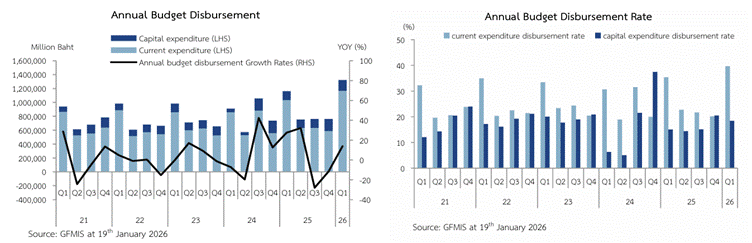
Source: Macroeconomic Strategy and Planning Division
(ii) The carry-over budget disbursement stood at 111,233.0 million Baht, increasing from the same quarter last year by 10 percent. The disbursement rate was 34.8 percent, accounting for current expenditure at 39.9 percent and capital expenditure at 34.2 percent and The State-owned enterprises’ capital expenditure budgetwas disbursed for 101,183.5 million Baht, reflecting a 9.7 percent decrease from the same quarter last year. This decrease was primarily due to a lower disbursement rate by the PTT Public Company Limited and its affiliated companies, the International Telecom Public Company Limited (NT), and the Provincial Electricity Authority (PEA). Thus, the top five state-owned enterprises with the highest disbursement values were the PTT Public Company Limited and its subsidiaries, the State Railway of Thailand (SRT), the Provincial Electricity Authority (PEA), the Electricity Generating Authority of Thailand (EGAT), and the Mass Rapid Transit Authority of Thailand (MRTA).
Financial Condition
The policy interest rate was reduced from 1.50 to 1.25 percent per annum during the fourth quarter of 2025, the Monetary Policy Committee (MPC), at its meeting on October 8th, 2025, voted 5 to 2 to maintain the policy interest rate. However, in the meeting on December 17th, 2025, the MPC unanimously voted to reduce the policy rate by 0.25 percentage pointsfrom 1.50 to 1.25 percent, which was the fourth reduction in 2025. This reduction aimed to support economic recovery and alleviate debt burden of vulnerable groups. The MPC’s policy rate cut was consistent with the monetary policy easing among several regional countries, including India and Philippines, and major economies including the United State, England, Canada, and New Zealand. Meanwhile, the central banks of China, South Korea, Vietnam, Malaysia, Indonesia, and the European Central Bank maintained their policy interest rates. In contrast, the Bank of Japan increased its policy interest rate by 0.25 percentage points to 0.75 percent per annum -the highest level in 30 years- as inflation remained above the target range and showed an upward trend.
Large and medium-sized commercial banks and specialized financial institutions (SFIs) reduced both deposit and lending rates in line with thereduction in the policy rate. In the fourth quarter of 2025, large commercial banks, medium-sized commercial banks, and SFIs lowered their 12-month fixed deposit rates from the averages of 1.10, 1.00, and 1.30 percent per annum to 0.86, 0.90, and 1.25 percent per annum, respectively. Similarly, their Minimum Loan Rates (MLR) declined from the averages of 6.69, 7.77, and 6.22 percent per annum to 6.60, 7.72, and 6.15 percent per annum, respectively. Average real deposit and lending rates across all banks were 1.51 and 7.33 percent per annum, declining from 1.87 and 7.60 percent per annum in the previous quarter. This decline was driven by the reduction in nominal average rates across all banks and a recovery in the inflation rate compared to the preceding quarter.
In January 2026, medium-sized commercial banks and SFIs lowered their MLR from the averages of 7.72 and 6.15 percent per annum to 7.67 and 6.12 percent per annum, respectively. For 12-month fixed deposit rates, large commercial banks and SFIs lowered the rates from the averages of 0.86 and 1.25 percent per annum to 0.85 and 1.18 percent per annum, respectively.
The Thai Economic Prospect 2026
The Thai economy in 2026 is expected to decelerate gradually, reflecting weaker export momentum amid a moderation in global economic activity. Nevertheless, the ongoing recovery in tourism and firmer domestic demand are projected to continue supporting overall expansion. Key economic drivers include higher public demand, consistent with an expanded fiscal framework, and a strengthening of private investment, underpinned by increased foreign direct investment inflows and a gradual improvement in private-sector construction activity. However, economic growth over the remainder of the year is likely to remain constrained by still-elevated household and corporate debt burdens. Moreover, downside risks persist from heightened volatility in the global economic and financial environment, climate change situation, and domestic political conditions that could delay the budget process and dampen overall economic sentiment. Under this circumstance, the Thai economy may deviate from the baseline projection.
Supporting factors for the economic growth:
The continued expansion of domestic private demand is expected to persist. Private consumption is projected to grow steadily, supported by improving income conditions, particularly from the recovery in the tourism-related sector and a strengthening labor market, as reflected in rising non-agricultural employment and a low unemployment rate. In addition, subdued inflationary pressures are expected to keep inflation low, thereby allowing monetary policy to remain accommodative. Private investment is also expected to strengthen, driven by continued expansion in investment in machinery and equipment, consistent with the significant increase in the value of investment promotion certificates issued during 2024 – 2025, which rose by 72.8 percent and 36.0 percent, respectively. Investment has been concentrated in digital industries, electronics and electrical appliances, and automotive and parts, which together accounted for 50.7 percent of total investment promotion value in 2025. The improvement in private investment is further supported by the accelerated growth in imports of capital goods as well as raw materials and intermediate goods since the second half of 2025. Meanwhile, construction investment is projected to expand, particularly in non-residential construction, especially industrial factories. This is reflected in the strong growth in permitted construction area in the last quarter of 2025, notably within industrial zones, which increased by 12.2 percent, accelerating from 6.9 percent in the previous quarter. This is consistent with higher activity in industrial estates, as the number of factories and the sold or leased area at the end of the year 2025 increased by 6.8 percent and 8.7 percent, respectively, from the same period a year earlier.
The increase in the public expenditure framework, covering both current and capital expenditures, is expected to serve as an important driver of government spending. Specifically, (1) the FY2026 annual expenditure framework amounts to 2.45 trillion baht, representing an increase of 7.9 percent from the previous fiscal year, comprising 1.80 trillion baht in current expenditure, up 5.6 percent, and 649 billion baht in capital expenditure, expanding by 14.8 percent. Based on the baseline assumption of a 90.6 percent disbursement rate for the FY2026 annual budget, consisting of 98.0 percent for current expenditure and 70.0 percent for capital expenditure, it is projected that total budgetary disbursement into the economy will reach 2.22 trillion baht, increasing by 6.0 percent. This amount comprises 1.76 trillion baht in current expenditure, up 3.3 percent, and 454 billion baht in capital expenditure, expanding by 18.2 percent. (2) The FY2026 carry-over expenditure framework totals 209 billion baht, declining by 8.0 percent from the previous fiscal year, comprising 30.3 billion baht in current expenditure and 178 billion baht in capital expenditure, representing an expansion of 4.2 percent and a contraction of 9.8 percent, respectively. Under the baseline scenario, the FY2027 annual budget is expected to experience a one-quarter delay in the budget preparation process due to the government transition. Consequently, the disbursement rate in the first quarter of FY2027 is projected at 20.3 percent, comprising 25.8 percent for current expenditure and 4.5 percent for capital expenditure. (3) The budget allocated under the economic stimulus and strengthening program amounts to 130,955 million baht, of which the remaining balance of approximately 43,482 million baht is expected to be disbursed within the first half of 2026.
The recovery of the tourism sector and related services is in line with the continued rise in both the number of international arrivals and tourism receipts. This trend is consistent with projections by the United Nations World Tourism Organization, which estimates that international tourism in 2026 will expand by 3 to 4 percent, with the Asia Pacific region expected to demonstrate particularly robust growth 37. In the case of Thailand, the tourism sector is supported by a significant rise in international flight capacity, attributable to aviation industry subsidies through reductions in aviation service charges. These measures have been complemented by sustained government initiatives, including efforts to elevate Thailand’s tourism standards toward health and cultural tourism under the Amazing Thailand 5Economy framework, as well as the organization of promotional activities under the “Thailand’s Grand Comeback 2026” campaign. As a result, international tourist arrivals in 2026 are projected to reach 35.0million, representing an increase of 6.1percent from the previous year.
Water availability conducive to cultivation has emerged as a key supporting factor underpinning the expansion of the agricultural sector, amid a projected transition of the El Nino–Southern Oscillation (ENSO) toward neutral conditions during the period from February to April 2026. Consequently, effective usable water storage in dams and reservoirs stood at 46 percent of total capacity as of 13 February 2026, compared with 39 percent in the corresponding period of the previous year. Nevertheless, the anticipated increase in agricultural output is likely to exert downward pressure on domestic agricultural prices. This trend is consistent with declining global agricultural commodity prices, reflecting the broader deceleration of the world economy and international trade.
Risks and limitations to economic growth:
Uncertainty and volatility in the world economy and global trade may affect Thailand’s economic growth and stability, with several downside risks to the global economy that need closely monitoring and assessment, including: (Uncertainties surrounding trade restriction measures by major economies, particularly risks related to trade policy implementation by the U.S., which may introduce additional trade measures, including the imposition of tariffs on transshipment goods, as well as retaliatory tariff increases on China, which are currently exempted until 10 November 2026. In addition, there are risks associated with U.S. trade measures linked to geopolitical conflicts, particularly the higher import tariffs on countries conducting business with and importing oil from Iran and Russia. These risks are compounded by domestic political developments in the U.S., which may heighten uncertainty surrounding trade policy, especially during the period awaiting the Supreme Court’s ruling on U.S. import tariff adjustments, as well as political pressures ahead of the U.S. midterm elections in late 2026; (Uncertainties arising from geopolitical conflicts, particularly tensions in the Middle East, the war between Russia and Ukraine, disputes in the South China Sea and the Taiwan Strait, as well as issues related to sovereignty over Greenland; (Divergence in monetary policy stances among major central banks amid inflation divergence, which may generate heightened volatility in financial markets, capital markets, and exchange rates; (Vulnerabilities in global supply chains for electronics and high-technology products, amid a potential downturn in the electronics cycle, together with the implementation of targeted import tariff measures by the U.S. focusing on high-technology products for national security purposes, as well as the use of non-tariff measures to control critical production inputs such as rare earth minerals and strategic metals, which may constrain global investment and exports of electronic products; (Risks stemming from capital market re-pricing, particularly among large technology firms whose market valuations have risen significantly following earlier waves of investment in artificial intelligence, which may affect the stability of the financial system and capital markets; and (Risks associated with elevated levels of public debt in many countries, which limit fiscal space and may exert upward pressure on government bond yields, potentially exposing developing countries and emerging market economies to confidence crises and debt defaults, leading to sudden capital outflows and heightened exchange rate volatility across regions.
The high level of household debt and constrained access to credit for SMEs remain key impediments to the recovery of domestic demand. The household debt-to-GDP ratio remains above its pre-COVID 19level, amid income growth that has yet to fully recover. This has resulted in persistent pressures stemming from household loan quality, prompting financial institutions to adopt a more cautious lending stance, thereby resulting in subdued growth in household credit extended by deposit-taking institutions. At the same time, the economic slowdown, coupled with the deterioration in the credit quality of SMEs, has induced financial institutions to further tighten lending standards, particularly for new SME borrowers. This has adversely affected access to financing and liquidity conditions for small scale borrowers and SMEs, constituting a structural constraint that is likely to exert sustained downward pressure on domestic demand over the longer term.
Increasing volatility of climate conditions, with a tendency toward greater severity and more frequent natural disasters, which may increasingly affect lives and property as well as disrupt economic activities. At the same time, several major economies have begun to enforce more stringent environmental regulations, particularly the implementation of the Carbon Border Adjustment Mechanism (CBAM) by the European Union, which came into effect on 1January 2026. This measure is expected to affect export-oriented industries with high carbon intensity, such as iron and steel, aluminum, fertilizers, and cement, and generate additional pressures on the business sector, especially small and medium-sized enterprises (SMEs) that still lack sufficient capacity and readiness to adjust to sustainability standards.
Post-election political conditions may affect business confidence and potentially delay the preparation process of the FY2027 annual budget, as well as the implementation of key policy measures, particularly trade negotiations with major partner countries. Under the baseline scenario, it is expected that a new government will be formed by May 2026, and that the FY2027 budget process will be delayed by approximately one quarter.
2) Outlook for the Construction and Construction Materials Business in 2026
2.1) Construction Business
Public construction in 2026 is expected to grow at approximately 1.00% per annum, facing pressure from a 5.00% reduction in the public investment budget for fiscal year 2026 compared to fiscal year 2025, as well as political uncertainty.
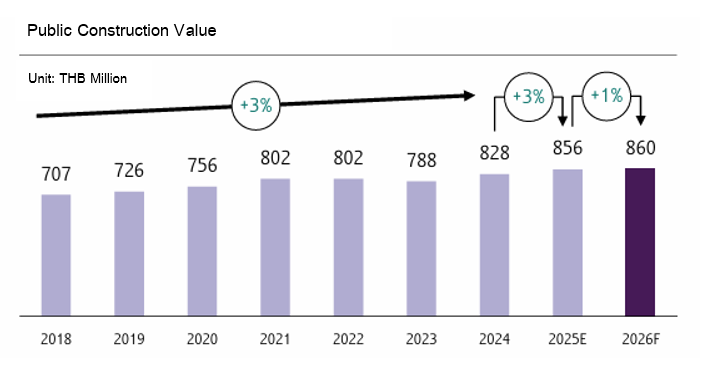
Source: Analysis by SCB EIC based on data from the Office of the National Economic and Social Development Council (NESDC) and the Bureau of the Budget.
In 2026, the public expenditure framework for fiscal year 2026 allocates THB 864,077 million for the investment budget, representing a 5.00% decrease compared to fiscal year 2025. This poses a challenge to the value of public construction in 2026. In addition, public debt may approach the 70% ceiling, which, if fiscal plans are not revised to align with the current environment of lower economic growth and inflation, could constrain the implementation of fiscal policy.
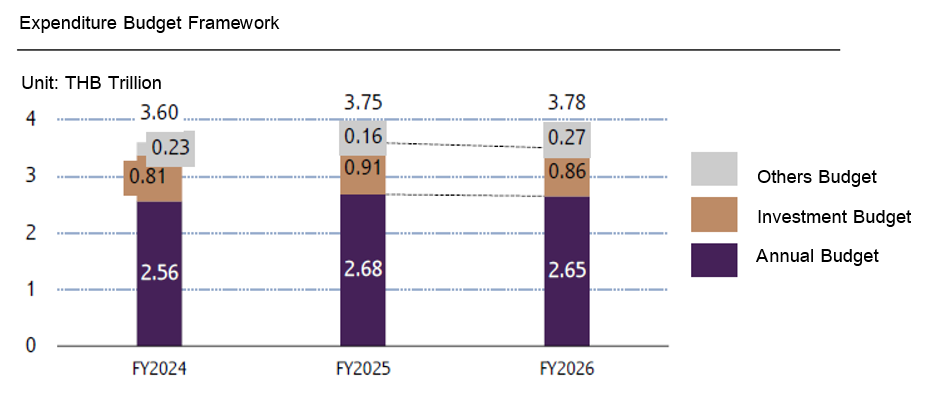
Source : Analysis by SCB EIC
However, ongoing mega projects continue to make progress, and in 2026, new mega projects are expected to be launched for bidding. This will result in a gradual inflow of investment into the public construction sector.
Example Mega Project | Project Value (THB Billion) |
High-Speed Rail Project (Bangkok–Nong Khai), Bangkok–Nakhon Ratchasima Section | 179 |
Orange Line MRT (Western Section), Bang Khun Non–Thailand Cultural Centre | 140 |
Laem Chabang Port Phase 3 (Section 1: Marine Construction Works) | 84 |
Purple Line MRT (Southern Section), Tao Poon–Rat Burana | 78 |
Double-Track Railway (Northern Line), Den Chai–Chiang Rai–Chiang Khong | 73 |
Map Ta Phut Port Phase 3 (Phase 1) | 64 |
Double-Track Railway (Northeastern Line), Ban Phai–Mukdahan–Nakhon Phanom | 55 |
Second-Level Expressway (Double Deck), Ngam Wong Wan–Rama 9 | 34 |
Motorway Bang Khun Thian–Ban Phaeo (Bang Khun Thian–Ekkachai and Ekkachai–Ban Phaeo Sections) | 29 |
Double-Track Railway Phase 2, Khon Kaen–Nong Khai | 29 |
Chalong Rat Expressway Extension, Chatuchot–Lam Luk Ka | 19 |
Intercity Motorway No. 7 Extension to U-Tapao Airport | 4.5 |
Source: Analysis by SCB EIC
Examples of New Projects Expected to Be Tendered in 2026 | Project Value (THB Billion |
High-Speed Rail Project, Nakhon Ratchasima–Nong Khai | 342 |
Double-Track Railway Phase 2 (3 sections: Chumphon–Surat Thani, Surat Thani–Hat Yai Junction–Songkhla, Hat Yai Junction–Padang Besar) | 104 |
Phuket Expressway (Phase 1 and 2) | 63.5 |
Don Mueang Airport Expansion (Phase 3) | 36.0 |
Second-Level Elevated Expressway, Ngam Wong Wan–Rama 9 | 34.8 |
Chalong Rat Expressway – Outer Bangkok Ring Road (Eastern Section) (Third Expressway Northern Line, Phase 1 – Former Section N2) | 13.7 |
Suvarnabhumi Airport Passenger Terminal (East Expansion) | 13.5 |
Source: Analysis by SCB EIC
For private construction in 2026, the total value is expected to continue contracting to THB 551,000 million, representing a 1.00% year-on-year decline. The value of residential construction is projected to decline further by 2.00% per annum, in line with the continued slowdown in the housing market. Meanwhile, the value of commercial real estate construction is expected to remain relatively stable. However, Thailand’s economic growth is expected to remain modest, and the number of international tourist arrivals is projected to decline in 2025, which may lead to delays in the launch of new projects.
Private Construction Value (THB Billion)
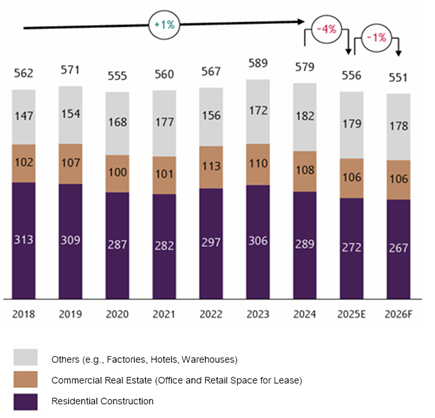
Source: Analysis by SCB EIC
Key Challenges in the Construction Industry in 2026 1) Persistently High Construction Costs: Although construction material prices are expected to decline in 2026, they remain elevated compared to historical levels (pre-2022). Close monitoring is required for the potential surge in steel imports from China, driven by U.S. tariff measures, as well as ongoing volatility in energy prices. In addition, the number of unskilled migrant workers from Myanmar has shown a declining trend since early 2025, which may exert upward pressure on wages. Despite the impact of the Thailand–Cambodia border tensions, it is expected that workers will not return to Cambodia, as wage levels in Thailand remain significantly higher. 2) Impact of Earthquake Events: The condominium construction segment continues to recover slowly, resulting in lost revenue opportunities for contractors. Consumer behavior has also shifted, leading property developers to increasingly emphasize contractor credibility as a key selling point. 3) Role of Chinese Contractors: The increasing presence of Chinese construction firms, often operating through Thai contractors as nominees, presents several risks, including: 1. Intensified price competition in bidding processes 2. Construction safety concerns 3. Project delivery issues 4. Negative impacts on related businesses within the supply chain, due to greater reliance on imported construction materials from China, such as steel, aluminum, and tiles
2.2 Construction Materials
In 2026, the construction materials industry is expected to slightly contract overall. This is mainly due to the anticipated decline in prices of key construction materials, including steel, cement, tiles, and paint, driven by lower raw material and energy costs such as iron ore, coal, oil, and electricity. In addition, intense price competition continues to exert downward pressure, particularly on tile prices. However, construction material prices remain elevated compared to historical levels (pre-2022). In terms of demand, the volume of construction material usage in 2026 faces pressure from the continued contraction in the residential construction sector, resulting in reduced demand for materials that rely heavily on private construction, particularly floor and wall tiles, as well as paint. Meanwhile, demand for long steel and flat steel in 2026 is expected to be approximately 6.5 million tons and 10.4 million tons, respectively. Cement consumption is projected at 36.1 million tons, remaining stable compared to 2025. The industry continues to face challenges from political uncertainty, which may affect public construction projects. Furthermore, the sector remains under pressure from competition with imported products, particularly from China, which continue to enter the Thai market, as well as from other countries redirecting exports to Thailand due to the impact of U.S. trade protection measures. As a result, both manufacturers and distributors of construction materials must adapt to an increasingly uncertain global trade environment.
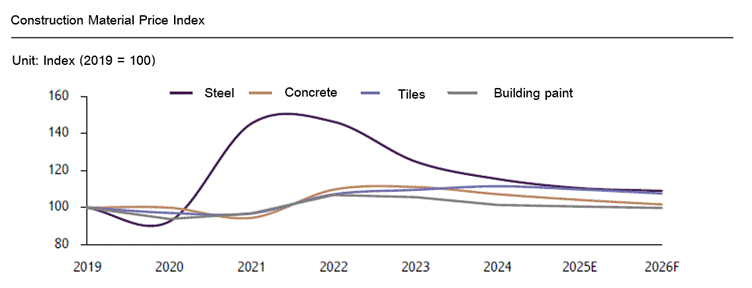
Source: Analysis by SCB EIC
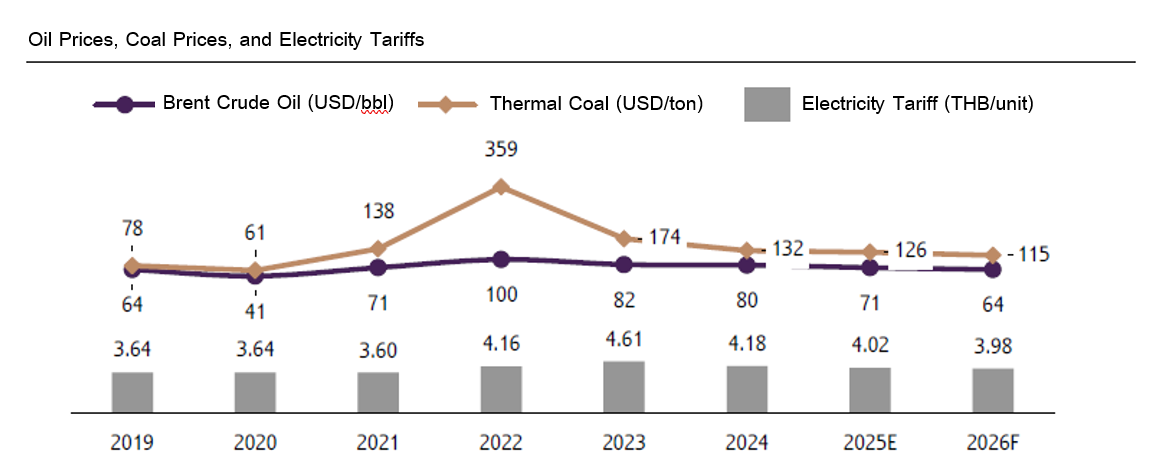
Source: Analysis by SCB EIC
2.3 Overview of the Domestic Construction Materials Price Index
According to data from the Trade Policy and Strategy Office (TPSO), the average construction materials price index over the 12-month period (January–December) of 2025 increased by 0.4%, compared to a 0.2% contraction during the same period in 2024.This increase was driven by the acceleration of public investment disbursement, particularly in large-scale infrastructure and public utility projects, such as mass transit systems, expressways, and airport expansion projects. In addition, demand for construction materials rose from renovation and refurbishment activities in tourism-related businesses, including buildings, hotels, and retail spaces, to accommodate tourist inflows. Furthermore, there was increased demand for construction materials used in the repair and reconstruction of roads, buildings, and residential properties following natural disasters such as earthquakes and floods in several areas. The rise in cement prices during the first quarter, resulting from manufacturers’ transition toward clean energy production processes, also contributed to higher production costs, which were passed on to consumers. In addition, several commodities particularly base metals used as key raw materials in construction materials production, such as copper and aluminum experienced price increases and high volatility. This was partly due to the impact of U.S. reciprocal tariff measures imposed on multiple countries, as well as increased demand from infrastructure development and clean energy projects.
The details of price changes by category are as follows:
Wood and Wood Products increased by 0.9%, driven by higher prices of formwork, window frames, and window panels, due to increased production costs in both raw materials and operations.
Cement decreased by 3.7%, reflecting adjustments in prices of Portland cement, blended cement, and ready-mixed plaster. This was influenced by price increases implemented by manufacturers in the first quarter, along with stronger demand from public infrastructure and utility construction projects.
Concrete Products increased by 0.9%, driven by higher prices of prestressed concrete piles, precast concrete beams, ready-mixed concrete, and concrete drainage pipes, in line with rising raw material costs (cement, stone, and sand).
Steel and Steel Products decreased by 2.4%, due to lower prices of round bars, deformed bars, H-beams, and steel sheet piles. This was mainly attributed to prolonged weakness in China’s real estate sector, resulting in excess steel supply and downward pressure on both steel prices and raw materials (billets and scrap).
Tiles decreased by 0.1%, reflecting lower prices of PVC floor tiles, ceramic floor tiles, and wall tiles, as developers delayed new project investments amid high levels of unsold property inventory.
Surface Finishing Materials increased by 0.1%, driven by higher prices of reflective road paint and oil-based coatings, supported by increased demand from transportation infrastructure construction and maintenance projects.
Sanitary Ware decreased by 2.7%, due to lower prices of toilets, showerheads, and stainless steel grab bars. This was mainly caused by developers postponing new investments amid high property inventory levels and tighter credit approval by financial institutions, which has had a prolonged and broad impact.
Electrical and Plumbing Equipment increased by 1.9%, driven by higher prices of VCT cables and NYY power cables, in line with significantly higher copper prices compared to the previous year.
ther Construction Materials increased by 2.3%, supported by higher prices of asphalt and natural materials (stone, soil, and sand), due to increased demand from construction and transportation infrastructure maintenance projects compared to the previous year.
2.4 Outlook for the Construction Materials Price Index in 2026
The construction materials price index in 2026 is expected to increase compared to 2025, driven by the following factors:
Rising prices of base metals used as key raw materials in construction materials production in the global market, such as copper and aluminum, supported by strong demand from infrastructure development and clean energy projects.
Stricter global environmental trade regulations, including the enforcement of environmental laws in many countries particularly the Carbon Border Adjustment Mechanism (CBAM) of the European Union which affects industries such as cement and steel. These industries are required to transition toward cleaner energy production processes, leading to higher production costs.
Increasing oil and energy prices, as major oil-producing countries (OPEC+) plan to suspend production increases during the first quarter of 2026 (January–March), due to concerns over potential oversupply in the global energy market.
However, there are factors that may cause the construction materials price index to deviate from expectations, as follows:
Delays in large-scale public construction projects (Mega Projects), such as high-speed rail, water resource management, and clean energy infrastructure projects, which may require Cabinet approval following the election.
Political uncertainty, which may lead investors to delay new project investments while awaiting clearer economic direction and policies from the post-election government.
High household debt and elevated property inventory levels, which continue to weigh on the real estate sector and are likely to result in a continued slowdown.
The prolonged real estate crisis in China, along with protectionist measures on steel imports in several countries, has led to excess steel supply, putting downward pressure on both global and domestic steel prices.
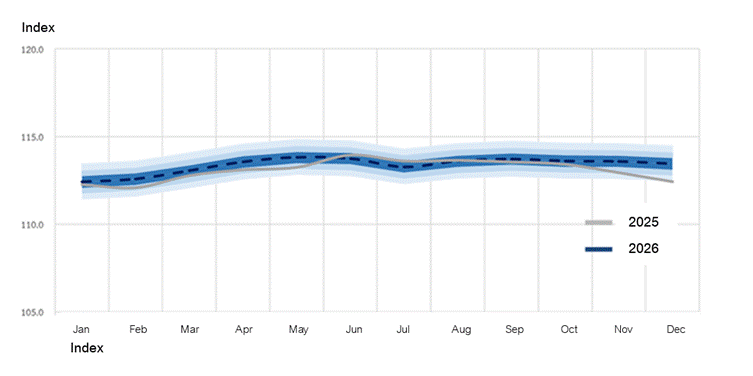
Source: the Trade Policy and Strategy Office (TPSO)
Overview of the Industrial Stone situation in the Eastern Economic Corridor (EEC)
The EEC project is a part of the Thailand 4.0 policy, covering three provinces in the Eastern region, namely Rayong, Chonburi, and Chachoengsao. The EEC project aims to enhance the competitiveness of both the manufacturing and service sectors based on modern technology and innovation. It focuses on the development of 12 target industries and aims to further develop the Eastern Seaboard area, known for over 30 years as the Eastern Seaboard, or "Eastern Seaboard."
Provinces in the Eastern Economic Corridor (EEC)
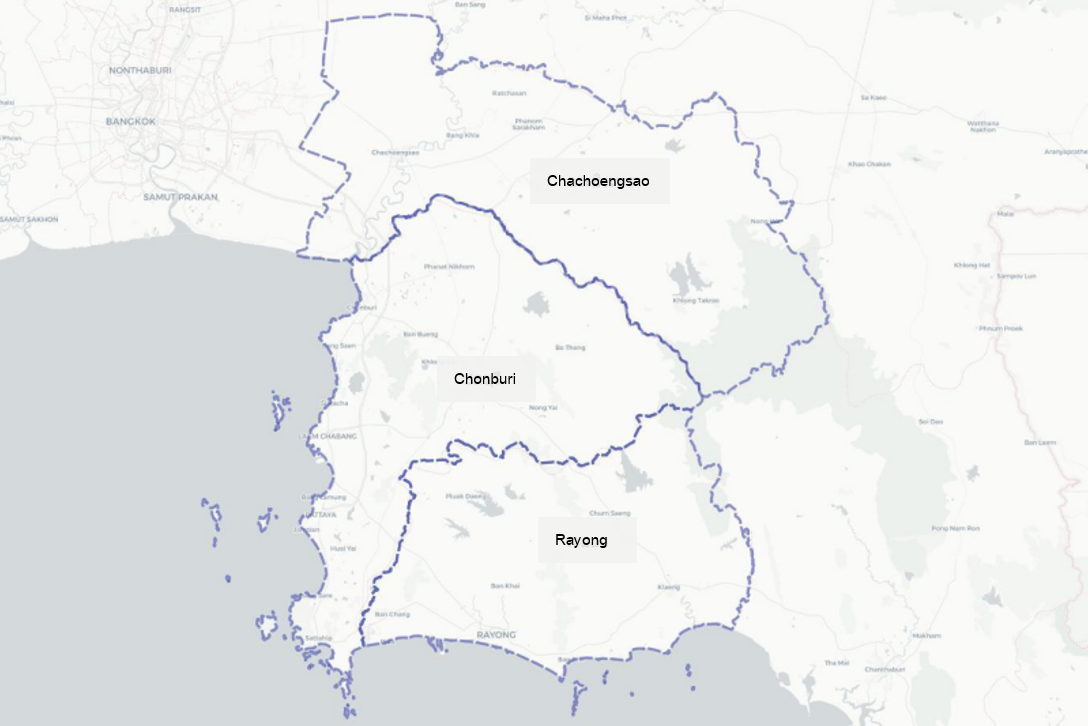
Source: Industrial Raw Material Management Division and Department of Primary Industries and Mines (DPIM)
The EEC Project has development plans included in the national strategy for the next 20 years; consisting of
peration plan on development of infrastructures.
peration plan on development of the digital infrastructure.
peration plan on development of business and financial centers.
peration plan on development of the targeted industries.
peration plan on development and promotion of tourism.
peration plan on development of personnel, education, research and technology.
In the meantime, the demand for industrial stone for construction as per the plan on the development of infrastructure under the EEC project as follows:
No. | Project | Demand for Limestone (Million tons) |
1 | Project high-speed rail linking the 3 airports | 27 |
2 | Project development of U-Tapao and Eastern flying city | 16.4 |
3 | Project Laem Chabang, phase 3 | 11 |
4 | Project Map Ta Phut Port, phase 3 | 8 |
5 | Project Intra-city Highway in the Eastern Region | 20 |
Total | 82.4 |
Source: Industrial Raw Material Management Division and DPIM
Moreover, during 1996 to 2021 the reserve volume in the concession of the entire stone sources in the EEC provinces equaled to 285.97 million tons, with the demand for limestone in the construction industry of the EEC project equals to 82.4 million tons. Thus, we shall have the remaining stone from being used in the EEC project equals to 203.57 million tons. It is projected that the demand to use industrial stone in the EEC provinces had the trend to increase by about 0.176 million tons every year.
In the projection on the time for the reserve volume remaining of the concession in the stone sources that can support the demand for industrial construction stone in the EEC provinces was about 10.5 years or until 2032. However, there is remaining reserve volume of some sources not mined, which some areas can be acquired a concession, it can increase the reserve volume in the future. Thus, it is expected that the reserve volume of the industrial stone for construction in the EEC provinces entirely can support the demand for industrial stone for construction for another 20 years.
Trend on Production and Utilization of the Stone and Minerals
The economic recovery can have effects positively to all sectors of the economic system of the country, including the stone mine and ore industry, which is the upstream industry, and has a demand due to the basic industries used stone and ore as raw material. Thus, the production and utilization of stone and ore for construction and cement industries, including other industries that need to use stone and ore as raw material. It is projected to have a trend to increase, with the main driving force comes from the investment in the large projects of the public sector, especially the projects related to the EEC. It included the economic situation that gradually recovers and supports the construction of residences and non-residences. Moreover, it can support the agriculture in the country as well. Thus, such factors can make the production and utilization of stone and ore for construction industry, cement and other industries involved, e.g. the glass production industry that needs dolomite as raw material, etc. likely to increase alongside as well.
Although the factors that have positive effect can create a better trend to increase the production and utilization of stone and ore, but Thailand may take time for economic recovery in the overall picture to return to the level before the pandemic of COVID-19. Therefore, it is expected that the stone mine and ore industry of Thailand was likely to be stable in the next few years.
Reserve Volume of the Industrial Stone
The areas that have been declared as industrial stone are in 327 places in 55 provinces with the total area of 143,687 rai (56,805.8 acres), and the total resource volume of 8,319.54 million tons. Most are located in the northern region at the ratio of 31.61 percent, followed by the central region at 31.51 percent, southern region 13.77 percent, northeastern region 9.16 percent, western region 8.96 percent and the least in eastern region at 4.99 percent, respectively.
Industrial stone reserves as announced in the central region are located in the provinces of Kanchanaburi, Prachuap Kiri Khan, Prachin Buri, Pethchaburi, Rachaburi, Lop Buri, Sa Keo, Saraburi, and Suphan Buri Provinces. In the northern region around Kamphaeng Phet, Chiang Rai, Chiang Mai, Tak, Nakhon Sawan, Nan, Phayoa, Phitsanulok, Phetchabun, Phrae, Mae Hong Son, Lampang, Lamphun, Sukhothai, Uttaradit and Uthai Thani Provinces. In the southern region around Krabi, Chumphon, Trang, Nakhon Si Thammarat, Narathiwat, Pattani, Phang Nga, Phattalung, Phuket, Yala, Ranong, Songkhla, Satun and Surat Thani provinces. In the northeastern region around Khon Kaen, Chaiyaphum, Nakhon Rachasima, Buriram, Loei, Si Sa Ket, Surin, Nong Khai, Nong Bua Lamphu, Udon Thani and Ubon Ratchathani Provinces. In the eastern region, located in the provinces of Chanthaburi, Chachoengsao, Chonburi, Trat and Rayong Provinces.
Thailand has the industrial stone reserves scattered in all its regions with the following details:
No. | Region | Number of Stone Source | Area (Rai) | Reserve Quantity | |||
Million MT | Percentage | ||||||
1 | Northern Region | 120 | 45,800.00 | 2,629.64 | 31.61 | ||
2 | North Eastern Region | 46 | 42,783.00 | 762.32 | 9.16 | ||
3 | Central Region | 31 | 17,478.00 | 2,621.80 | 31.51 | ||
4 | Eastern Region | 24 | 8,743.00 | 414.88 | 4.99 | ||
5 | Western Region | 22 | 7,595.00 | 745.11 | 8.96 | ||
6 | Southern Region | 84 | 21,288.00 | 1,145.79 | 13.77 | ||
Total | 327 | 143,687.00 | 8,319.54 | 100.00 | |||
Source: Department of Primary Industries and Mine on February 2026 (Latest Edition)
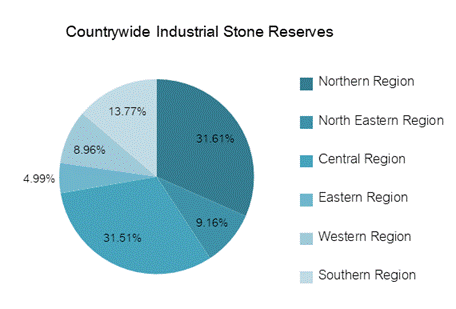
Source: Department of Primary Industries and Mine on February 2026 (Latest Edition)
Stone Reserve in Chonburi Province
The stone in Chonburi Province has a total of six sources consisted of Khao Cha-ang Krom Khlong, Khao Chaeng Tian, Khao Ban Khlong Kum, Khao Phu Khao Wang Pla and Khao Wang Pla (additional), with the total reserve volume of 91.86 million metric tons, covering 2,750 rai (1,087.3 acres) or 22.14 percent of the eastern region reserve with the following details:
No. | Name of Stone Source | Location | Area (Rai) | Reserve Quantity | |
Million MT | Percentage | ||||
1 | Khao Cha-ang Krom Khlong | Bo Thong Dist. | 498 | 19.52 | 21.25 |
2 | Khao Chaeng Tian | Mueang Chonburi | 1,000 | 29.39 | 31.99 |
3 | Khao Ban Klong Kum | Bo Thong District | 300 | 13.70 | 14.91 |
4 | Khao Phu | Mueang Chonburi | 750 | 21.00 | 22.86 |
5 | Khao Wang Pla | Sattahip Dist. | 100 | 5.25 | 5.72 |
6 | Khao Wang Pla (Additional) | Sattahip Dist. | 102 | 3.00 | 3.27 |
Total | 2,750.00 | 91.86 | 100.00 | ||
Source: Department of Primary Industries and Mine on February 2026 (Latest Edition)
Based on the above information, it reflects the reserve volume of the area in Chonburi Province, where the Company’s granite quarry is located. The Nong Kha Granite Quarry (Mining License No. 21400/15786) has ceased blasting operations since December 2025, as the mineable reserves have been fully depleted.
However, the Company maintains a stockpile of large rock for sale to contractors involved in large-scale government construction projects, as well as raw material inventory to supply its crushing plant for the production of 20 mm construction aggregates, which is the Company’s main product. It is expected that production and sales will continue until the end of the second quarter of 2026.
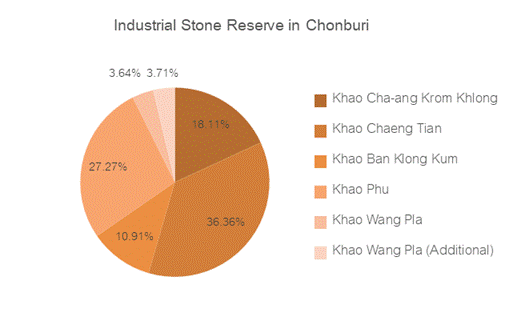
Source: Department of Primary Industries and Mine on February 2026 (Latest Edition)
Stone Reserves in Rachaburi Province
In Rachaburi Province there are total of four stone sources consisted of Khao Tok Nam, Khao Phra Ek, Khao Sam Ngam and Khao Ang Hin, with the total reserved quantity of 102.76 million tons, covering 1,660 rai (664 acres) or 3.12 percent of the reserve volume of the central region with the following details:
No. | Name of Stone Source | Location | Area (Rai) | Reserve Quantity | |
Million MT | Percentage | ||||
1 | Khao Tok Nam | Mueang Dist. Pak Tho | 113 | 10 | 9.73 |
2 | Khao Phra Ek | Mueang Dist. Pak Tho | 260 | 17 | 16.54 |
3 | Khao Sam Ngam | Pak Tho Dist. | 987 | 64.76 | 63.02 |
4 | Khao Ang Hin | Pak Tho Dist. | 300 | 11 | 10.70 |
Total | 1,660 | 102.76 | 100.00 | ||
Source: Department of Primary Industries and Mine on February 2026 (Latest Edition)
From the above data it shows the reserve volume of the area in Rachaburi Province, where is the location of the limestone and dolomite mines of our subsidiary. If compared with the ratio of the reserve volume of limestone and dolomite that our company has at present in the quantity of 14,871,786.87 metric tons (estimated on 5 September 2023) the reserve volume of our subsidiary is 14.47 percent of the reserve volume of the entire stone source in Rachaburi. Because the stone source in Rachaburi scattered in multiple areas with the data on the stone source of Rachaburi above was the collection of the basic reserve volume. It is based on the area characteristics of the mountainous area only. Meanwhile, it may not cover the operators of the stone mines at the present.
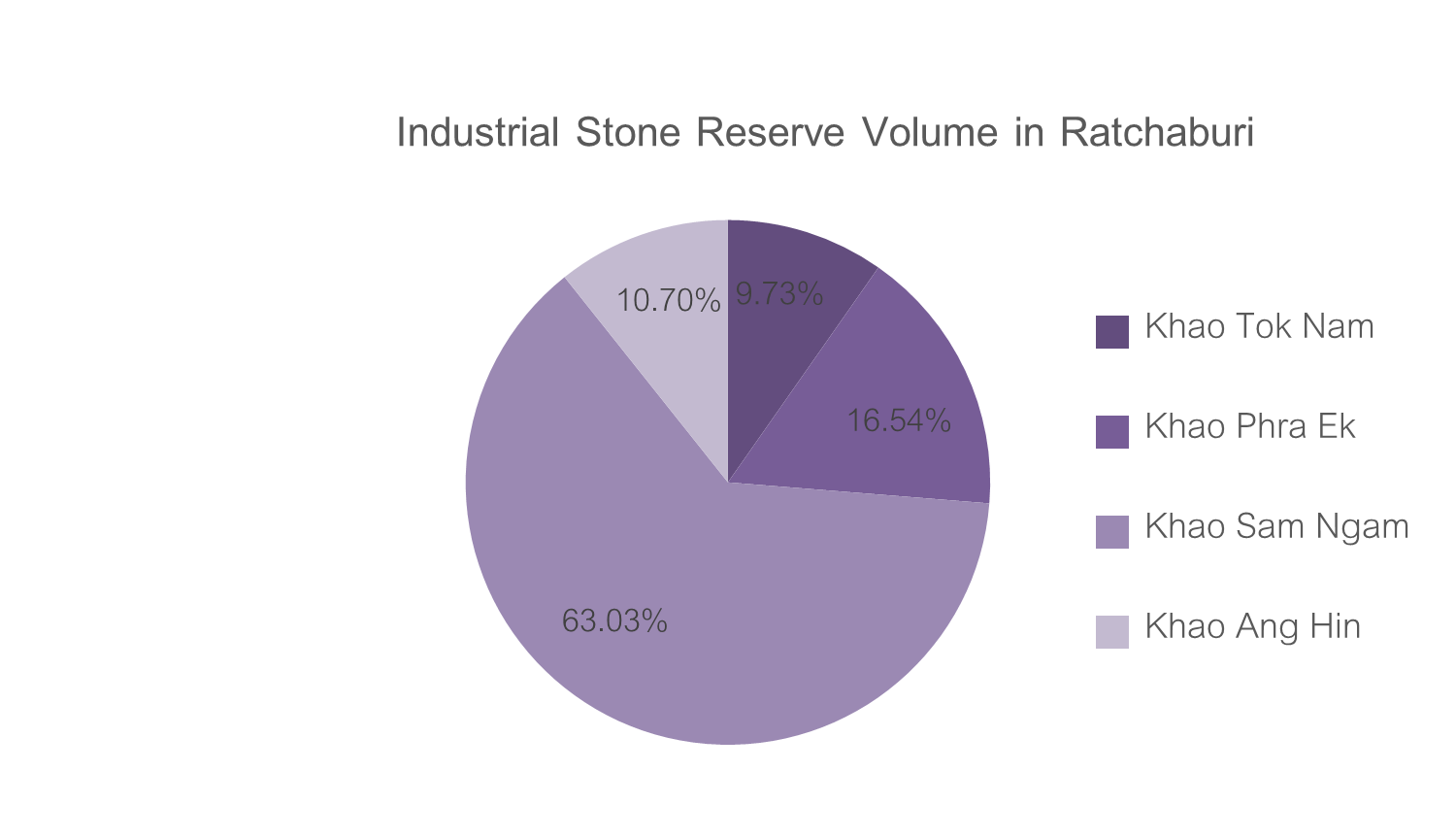
Source: Department of Primary Industries and Mine on February 2026 (Latest Edition)
Stone Reserves in Phetchaburi Province
There are a total of 2 stone resource sites in Phetchaburi Province, namely Khao Tok Nam and Khao I Bit, with a combined reserve of 323.91 million metric tons, covering a total area of 1,539 rai, representing 43.47% of total reserves in the Western region. Details are as follows:
No. | Name of Stone Source | Location | Area (Rai) | Reserve Quantity | |
Million MT | Percentage | ||||
1 | Khao Namtok | Chaum Dist. | 94 | 3.01 | 0.90 |
2 | Khao Ebit | Khao yoi Dist. | 1,445 | 320.90 | 99.10 |
Total | 1,539 | 323.91 | 100.00 | ||
Source: Department of Primary Industries and Mine on February 2026 (Latest Edition)
The above data shows that the reserve volume of the area in Phetchaburi province, which is the location of the company's limestone mine area, if compared the ratios of the reserve volume of the limestone that the company has as of 31 December 2025 is 24.21 million metric tons (appraised on 22 February 2024). The Company’s reserve volume has the ratio of 7.54 percent of the total reserve volume in the entire Phetchaburi Province.
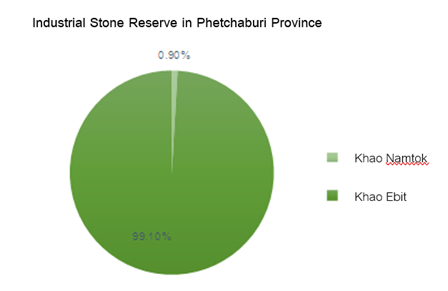
Source: Department of Primary Industries and Mine in February 2026 (Latest Edition)
Concession areas for stone mining industry
The issuance of concessions for industrial stone mining falls under the responsibility of the Department of Primary Industries and Mines (DPIM). Nevertheless, the operator can apply for a concession both on their own area or belonging to a public agency that is designated as a stone industry.
The data summarized the concession holdings around Thailand, especially the applications for granite and limestone industrial stone type for construction and dolomite, which is the same concessions with the company and its subsidiary only with the following details:
Type of Stone | Quantity (Certificate) | Type of Certificate | Concession Area (rai) | Term (Average) |
Granite | 74 | Operate | 10,592 | 22.41 |
Limestone | 526 | Operate | 97,412 | 21.38 |
Dolomite | 32 | Operate | 4,226 | 18.88 |
Total | 632 | 112,230 | 20.89 |
Source: Department of Primary Industries and Mine on 14 February 2025 (Latest Edition)
The data on holding concession of stone industry type of granite and limestone for construction and dolomite had a total of 632 certificates, or about 112,230 rai around the country. Most of the concessions applied to limestone due to large reserve volume easily found and scattered around the country.
Competition
Competition in the business of producing granite for construction, limestone for construction, and dolomite minerals depends on producers located in close proximity or within the same province. This is because the characteristics and properties of stones and minerals from different sources are similar and can be used interchangeably. Additionally, these products are heavy and require transportation by trucks. For general projects that do not require specific characteristics of stones and minerals, the key factor depends on transportation costs. Therefore, if stone and mineral sources are far from the customer's site, transportation costs will be high, leading customers to choose services from producers near their own sites.
Moreover, concerning the specific chemical properties that customers require, particularly for dolomite minerals, competition not only considers transportation costs as a primary factor but also requires customers to test the chemical properties and impurities of minerals to meet their specific needs. These chemical properties are naturally occurring and cannot be further modified or enhanced.
Currently, the level of competition between companies and other producers of stone and minerals is not particularly high. This is because both companies and other producers have limited time for blasting and crushing stones each day, resulting in limited quantities of blasted and crushed stones. Moreover, operating a stone and mineral production business requires obtaining permits from the Department of Primary Industries and Mines, as well as various other related licenses, such as factory operation permits, environmental impact assessment reports, permits for hazardous activities to health, permits for explosives acquisition, usage, and transportation according to specified types and quantities. Therefore, specialized knowledge and expertise are required, along with significant investment capital to operate such businesses. Consequently, this situation creates barriers for new entrepreneurs who intend to enter the industry.
Competition Situation on the Products
Industrial stone for construction of the granite and limestone types
The competition of industrial stone for construction is among the domestic producers in the nearby areas because of the transport cost is the important factor and obstacle for outside operator in the radius exceeding 150 km from the mine location. The company has high potential in competition due to a quality management production system, capable of producing high-quality stones that meet various customer demands. This includes both main products such as 20 mm. stones and customized products according to customer orders, such as Ballast or stones of various sizes tailored to specific usage requirements.
Furthermore, the company continuously improves and develops its production processes and adheres firmly to agreements with customers. This instills confidence and satisfaction in customers regarding the company's ability to produce high-quality stone products and deliver them within the specified timeframes.
Dolomite
For competition in dolomite minerals, which is a new product for the company, dolomite minerals can be produced from the Chom Bueng mine, strategically located within the customer's strategic location group. This is suitable for the Dolomite Mineral business as transportation is a critical factor in presenting proposals to customers. Additionally, the distance from customers to the company's mine site is advantageous in terms of distance compared to several competitors.
However, at present the customers in the central region mostly purchased dolomite from a few large producers. When considering the environmental condition of the market overall, the company had to compete directly with the large producers in the central region area. Currently, customers in the central region purchase dolomites from a few major producers due to the high production standards and quality of the products. The company's dolomite products are divided into Dolomite Lump and Dolomite Powder. In 2025, Dolomite Lump size 60-100 mm sales increased significantly from 2024, with the product's quality earning customer trust and orders. Since production of Dolomite Powder in Q2 2023, the company has secured long-term contracts (1-3 years) with major customers to reduce the risk of sourcing high-quality raw materials for production.
Procurement of Products & Services
Reporting Mode
3117
Procurement (Overall)
As the company's core business is the production and distribution of industrial stone products, including dolomite, the company will commence with investments in quarrying, focusing on owning the land rights of the rock sources, as well as the relevant licenses for business operations.
Methods for sourcing key raw materials can be implemented in 2 ways: 1) developing new quarries and 2) acquiring existing quarry businesses. Details for each method are as follows:
Development of new quarries
The development of new quarries will be undertaken when there are areas with potential rock sources for quarry development, and the company is interested in operating a business in that area. The company will develop new quarries
Acquisition of existing quarry businesses
The acquisition of existing quarry businesses will be undertaken when there are operational quarry businesses located in suitable areas.
Raw Material Acquisition (Overall)
The company procures key raw materials for production from various suppliers. The purchasing department is responsible for acquiring goods and services that meet specified requirements and appropriate quality standards, at fair and cost-effective prices. This process involves sourcing multiple vendors for comparative evaluation, ensuring their capability to deliver goods on schedule, and verifying the presence of a robust quality management control system.
Production Policy (Overall)
Production Policy
The company plans its production to align with customer demand and regularly reviews its production plans. The company and its subsidiaries operate stone mines totaling 3 sources, as follows:
Industrial Stone Quarry, Granite Type, for Construction Industry ("Nong Kha Quarry")
Concession License No. | : | 21400/15786 |
Stone Type | : | Granite for construction industry by bench mining method |
Location | : | Bang Phra Subdistrict, Si Racha District, Chonburi Province |
Concession Period | : | November 26, 2017 - November 25, 2032 |
Concession Area | : | 85-1-07 rai or 34,007 square wah, which is company-owned land. |
Remaining Reserves | : | Quantity: -0- million tons (as of December 31, 2025) |
Mining Method | : | Bench Mining Method |
Concession Holder | : | Stone One Public Company Limited |
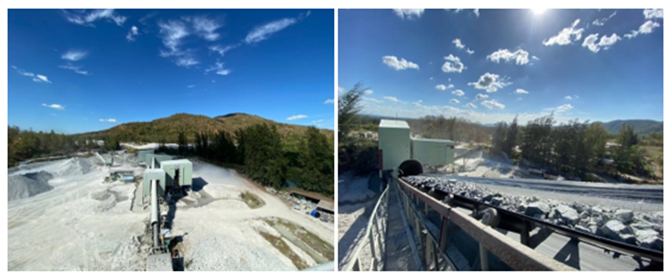
Industrial Stone Quarry, Limestone and Dolomite Ore Type ("Chom Bueng Quarry")
Concession License No. | : | 21128/16246 |
Stone Type | : | Limestone and dolomite ore for construction industry by bench mining method |
Location | : | Rang Bua Subdistrict and Chom Bueng Subdistrict, Chom Bueng District, Ratchaburi Province |
Concession Period | : | August 18, 2017 - August 17, 2042 |
Concession Area | : | 272-1-30 rai or 108,930 square wah. This land is not owned by the company or its subsidiaries but has been granted permission for utilization within forest areas under Section 4 (1) of the Forest Act B.E. 2484 (1941). |
Remaining Reserves | : | Limestone reserves amount to 7.76 million tons and dolomite ore reserves amount to 0.99 million tons (as of December 31, 2025). The actual utilization volume depends on the production plan at the mine face. |
Mining Method | : | Bench Mining Method |
Concession Holder | : | Rachaburi Enterprise Co., Ltd. (Subsidiary) |
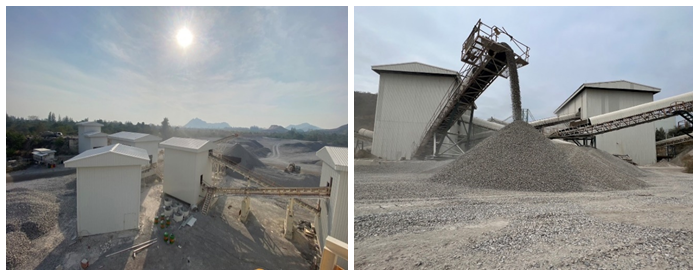
Industrial Stone Quarry, Limestone Type ("Khao Yoi Quarry")
Concession License No. | : | 26592/16503 |
Stone Type | : | Limestone for construction industry by open-pit mining method |
Location | : | Nong Chumphon Nuea Subdistrict, Khao Yoi District, Phetchaburi Province |
Concession Period | : | September 22, 2022 – September 21, 2051 |
Concession Area | : | 96-2-65 rai or 38,660 square wah. This land is not owned by the company or its subsidiaries but has been granted permission for utilization within forest areas under Section 54 of the Forest Act B.E. 2484 (1941). |
Remaining Reserves | : | Limestone reserves amount to 24.21 million tons (as of December 31, 2025). The actual utilization volume depends on the production plan at the mine face. |
Mining Method | : | Open-pit mining method |
Concession Holder | : | Boonthavorn Mining Co., Ltd. |
Details of the Company's and Subsidiaries' Crushing Plants
Nong Kha Mine Crushing Plant, which is used to produce Aggregate 20 mm, G-sand or Ballast, stone dust and Aggregate 6 mm.
Factory Operating License No.: | Thor 3-3 (1) - 2/40 ChB. (Stone Crushing, Grinding, and Screening Plant) Jor 3-3 (3) - 1/50 ChB. (Sand Washing Plant) |
Production Capacity: | Primary crushing approximately 1.92 million tons/year Secondary crushing approximately 1.92 million tons/year |
Actual Production Capacity Utilization: | Granite approximately 0.57 million tons/year (2025 production volume) |
Operated by: | Stone One Public Company Limited |
Utilization: |
|
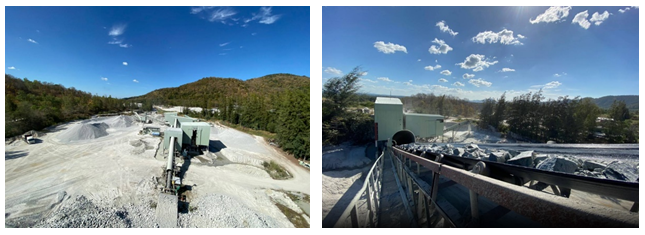
Illustration of Nong Kha Quarry Crushing Plant
Chom Bueng Quarry Crushing Plant, which is used to produce the company's main products, namely Aggregate 20mm and 6 mm.
Factory Operating License No. | Thor 3-3 (1) - 2/40 RB. (Stone Crushing and Grinding Plant) |
Production Capacity | Primary crushing approximately 2.40 million tons/year Secondary crushing approximately 2.40 million tons/year |
Actual Production Capacity Utilization: | Limestone approximately 1.50 million tons/year (2025 production volume) |
Operated by: | Rachaburi Enterprise Co., Ltd. |
Utilization: |
|
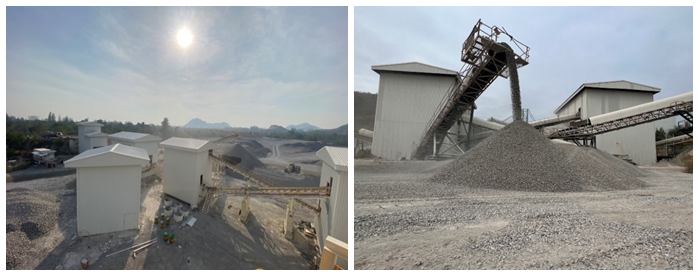
Illustration of Chom Bueng Quarry Crushing Plant
The dolomite processing plant is designed for the production of both lump dolomite (Lump Process) and powdered dolomite (Powder Process). The company's dolomite processing plant is designed for continuous production in both Phase 1 and Phase 2 to support production plans based on market and customer demands. Currently, Dolomite Processing Plant Phase 1 can produce dolomite in three sizes: 60-100 mm, 30-60 mm, and 0-30 mm. The company can adjust product sizes to various specifications depending on market volume and demand at the time. Dolomite Processing Plant Phase 2 is for producing powdered dolomite products, complete with a quality control laboratory. DLM 2 specifically produces dolomite ore with a size of 0-325 Mesh, used in the glass, mirror, construction industries, and for soil conditioning. The production process of DLM 2 can operate both continuously and independently from DLM 1, with production plans adjustable according to market and customer needs.
Mineral Dressing License | 3/2021 |
Production Capacity 1/ | DLM 1 0.60 million tons/year and DLM 2 approximately 0.18 million tons/year |
Actual Production Capacity Utilization | DLM 1 and DLM 2 approximately 0.39 million tons/year (production volume in 2025) |
Operated by | Rachaburi Enterprise Co., Ltd. |
Utilization |
|
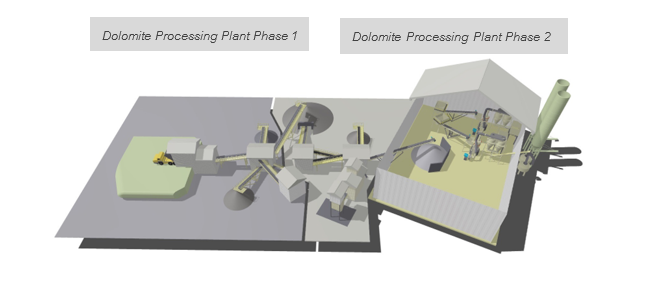
Dolomite Processing Plant Phase 1 and 2 Flowchart
Production Process and Technology
(1) Industrial Stone for Construction
The company's industrial stone production and distribution process can be divided into three main stages: Mining, Crushing, and Marketing.
The industrial stone production process for both granite (Nong Kha Quarry) and limestone (Chom Bueng Quarry) shares similar main production steps. The differences lie in minor details such as machinery characteristics, various equipment, and product processing. This is because granite possesses distinct physical properties from limestone, having higher material strength than limestone, a tightly interlocking rock matrix, and high-hardness constituent minerals, leading to higher production costs compared to limestone.
Furthermore, the dolomite ore production process is similar to that of limestone, with differences such as product size and quality control.
1) Mining
The company's and its subsidiaries' rock quarries operate using the bench mining method, which involves blasting and excavation to create a stepped mine (Benching) with bench heights of approximately 8-10 meters and widths of no less than 8-10 meters. The benches typically start from the central surface area of the mine and are excavated downwards in a circular pattern. This applies to the limestone and dolomite mines at Chom Bueng, which are mountain-based mines, and for the Nong Kha mine, which is a flatland mine excavated below ground level.
For mining, the initial steps involve stripping and drilling. Subsequently, blasting is performed to break up rocks and soil layers, followed by loading the blasted rocks into the crushing and grinding plant. The company utilizes specialized dump trucks to transport rocks from the mine area to the crushing plant for further processing.
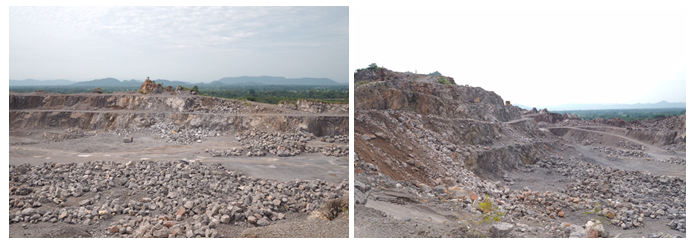
Illustration of Bench Mining Method
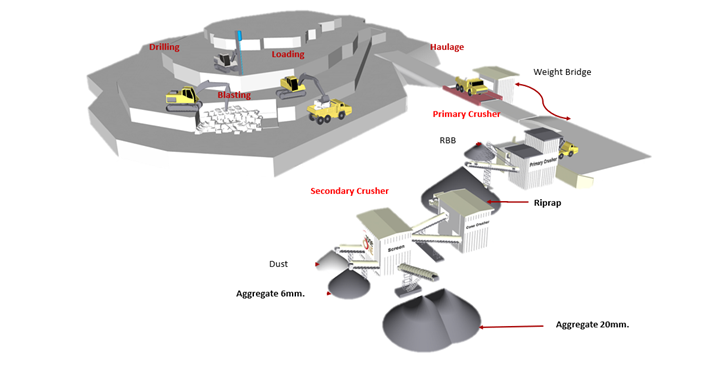
Illustration of Construction Stone Production Process
In managing the mine area and its surroundings, land use zoning is implemented in accordance with environmental impact prevention measures. Trees are planted around the project area to enhance the landscape and preserve the environment. Environmental quality, including dust, noise levels, water, and vibrations, is monitored according to the requirements of the Environmental Impact Assessment (EIA) report.
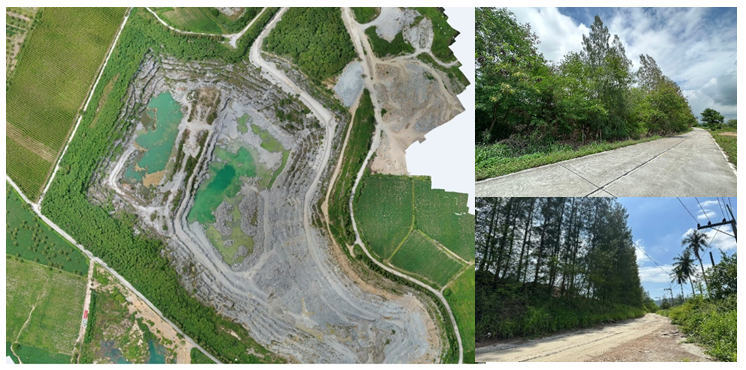
Illustration of tree planting for Nong Kha mine rehabilitation
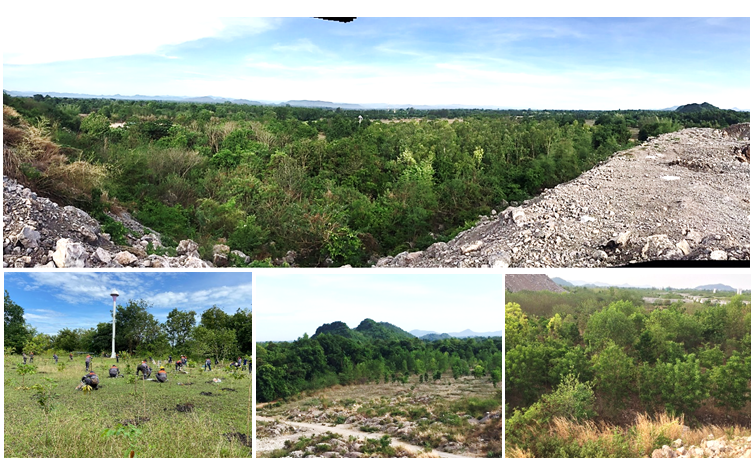
Illustration of tree planting for Chom Bueng mine rehabilitation
2) Crushing
Stone crushing involves reducing the size of rocks using a crusher. Rock crushing utilizes compression and impact from hard materials to break down rocks into smaller sizes suitable for conveyor belt transport. The conveyor belt system is fully enclosed and equipped with water sprayers at dust generation points to reduce airborne dust from the crushing process. The company's crushing plants include both primary crushers and secondary crushers to achieve desired stone sizes. Primary crushing yields main products such as large rip rap stones, as well as RBB and RBC stones as by-products. Secondary crushing yields main products such as aggregate 20 mm and 6 mm, as well as stone dust as a by-product.
Furthermore, the crushing plant has established dense, tall tree lines to block wind and noise as appropriate. It also features drainage channels and dust traps in various areas of the crushing plant to collect dust sediment from rainwater runoff and cleaning, which is then buried.
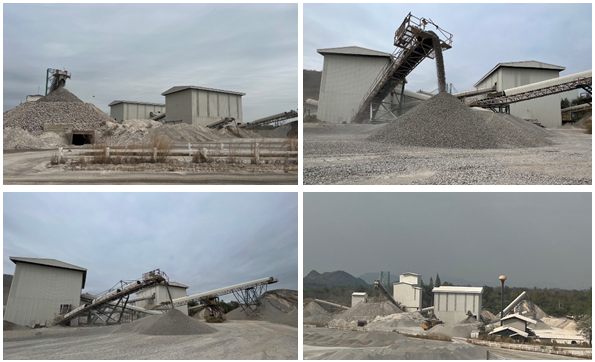
Illustration of Construction Stone Crushing Plant
3) Sales (Marketing)
Sales Process: Stone products are stockpiled in designated areas after sizing. Trucks transport the stone, and weighing is conducted via a weighbridge. There are generally two methods of transportation: 1) customers transport the stone themselves using their own trucks, and 2) utilizing the company's transportation services, where the company's logistics department delivers products to customers.
All stone trucks, before leaving the crushing or grinding plant, must pass through a wheel washing area to clean the truck wheels, ensuring cleanliness and preventing dust dispersion. Additionally, the cargo area is covered with tarpaulins.
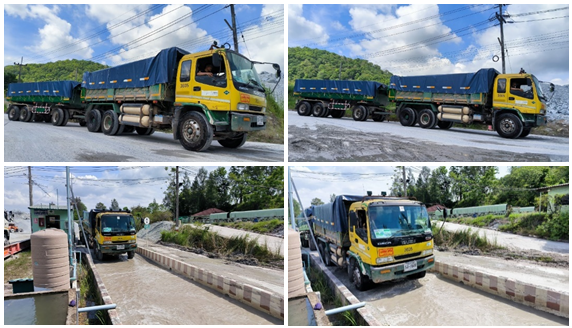
Illustration of a Truck
(2) Dolomite
The company commenced dolomite production at Chom Bueng Quarry, with a plan to utilize existing dolostone from the limestone mine to produce dolomite, thereby expanding its product portfolio to target diverse customer segments. The company anticipates that dolomite produced from Chom Bueng Quarry, Ratchaburi Province, will be able to meet the demands of customers in the central region and nearby areas. A survey of dolomite demand in areas near the company's factory revealed that customers in the central region primarily use dolomite ore in the construction, glass, and mirror industries. For large-scale dolomite production in the southern region, it is mainly used in the agricultural sector for soil conditioning and for export.
(2.1) Dolomite Phase 1 (Lump)
1) Mining
The Dolomite Phase 1 ("Dolomite Phase 1" or "DLM1") mining process is similar to current limestone mining, differing only in product size and quality control. For dolomite ore production, the company plans Phase 1 dolomite production separately from limestone production. As of December 31, 2025, dolomite reserves amount to 0.99 million tons. Currently, the dolomite production area is separate from the limestone mining area. However, if dolomite sales improve in the future, the company can revise its mining plan by requesting permission to expand the dolomite production area. This is because surveys of the company's limestone mine area indicate remaining limestone and dolomite reserves at depths ranging from 70 meters to 20 meters, estimated at approximately 16.55 million tons (referenced from the mineable reserve assessment report for concession license no. 21128/16246 of Chom Bueng Quarry as of September 2021). Nevertheless, if the company plans to increase dolomite production beyond the original mining plan, it must submit a request for permission to the Department of Primary Industries and Mines (DPIM).
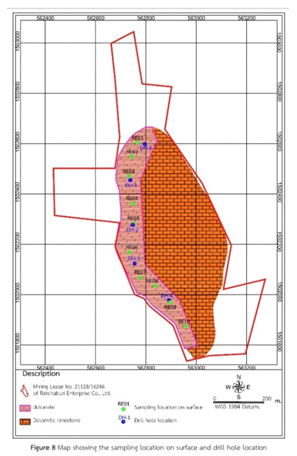
Illustration of the Dolomite Mining Flowchart
2) Crushing
In dolomite production, after each blast, rocks no larger than 800 mm are obtained. The company transports these large rocks (Big Rock) from the blasting site to the dolomite processing plant to feed them into a Jaw Crusher. Subsequently, fine dolomite products no larger than (0-150 mm) are obtained and then sent to a 3-layer Conveyor Belt system for stone separation. If rocks entering the production process are still larger than 100 mm, they are conveyed to a Cone Crusher for further crushing, which can crush rocks larger than 60 mm to a smaller size, and then conveyed for further processing. The company's Dolomite Processing Plant Phase 1 is designed with a Triple Deck Screening system to separate the largest rocks, ranging from 60-100 mm, on the first deck. These are then passed through a Cone Crusher to achieve smaller sizes, conveyed to the second deck for production of 30-60 mm rocks, and the third, bottommost deck yields 0-30 mm rocks.
Currently, the production process of Dolomite Processing Plant Phase 1 can produce lump dolomite in three sizes: (1) 0-30 mm, (2) 30-60 mm, and (3) 60-100 mm, with production ratios of 25:25:50, respectively. The company can adjust these production ratios according to product demand at any given time.
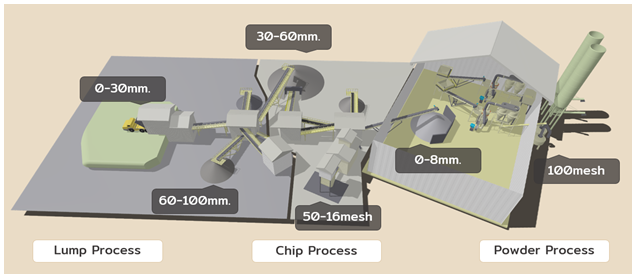
Dolomite Processing Plant Phase 1 and 2 Production Flowchart
3) Sales (Marketing)
The sales process for dolomite products is similar to that of limestone. Dolomite products are stockpiled separately according to their three sizes: small (0-30 mm), medium (30-60 mm), and large (60-100 mm). The company offers both direct sales, where customers pick up products at the factory, and sales including transportation, similar to granite and limestone sales. The company's sales department conducts market research and inquires about customer needs to provide data for the production department to plan dolomite production for each type. This is because the company's current customers have diverse needs, including using dolomite products in furnaces, glass and mirror manufacturing plants, cement factories, steel production facilities, and the agricultural sector.
Regarding pricing policy, the company determines prices based on market surveys and customer demand. For all three sizes of dolomite products, different prices are set depending on product size, chemical properties, production complexity, quality control, and product delivery. Dolomite products used in glass and mirror factories command relatively high values due to the necessity of specific chemical and property testing as required by customers.
(2.2) Dolomite Phase 2 (Dolomite Powder)
1) Chip Process
The Chip Process involves transforming 0-60 mm dolomite, obtained from Phase 1 production, from lump form into powder. Dolomite from the surge pile is sent to a Gyradisc Crusher to be ground into smaller Chip Products, sized 16-50 mesh (or equivalent to 1.19-0.2 mm). In the Chip Process, the screening system consists of three layers: the top layer separates dolomite larger than 6 mm, while the second and third layers separate particles to a size no larger than 3 mm. Subsequently, the stone is sent to a Swing Screen, a closed-system vibrating screen, to separate dolomite into fine Chip Products. The products obtained from the Chip Process will be 16-50 mesh in size. These Chip Products are then stored in a hopper, awaiting sale to customers. Customer groups requiring this size of dolomite include glass and mirror manufacturers.
Chip Product Quality Inspection
During the quality inspection process, random checks are conducted from the raw materials fed into the crusher to the finished products, in order to control contamination and chemical properties, which are crucial components of Chip Product manufacturing. The company performs random quality checks on products every 30 minutes of the production cycle to ensure they meet the required size and specifications. In cases where products exhibit abnormal characteristics or do not meet specified sizes, the quality inspection department will immediately notify the production department to identify the cause and implement corrective actions.
2) Powder Process
The Powder Product manufacturing process is a closed-system operation because the resulting products are fine and require control over moisture and specific properties. In the Powder Process, a loader is used to scoop 0-8 mm dolomite into a Loading Hopper and convey it to a Raymond Mill, which can grind it to a fineness of 50-325 Mesh. The Raymond Mill system utilizes grinding rollers and a blower to separate dolomite, which is then sent to a Hydrocyclone for size classification, where lighter particles float and appropriately sized dolomite settles to the bottom, then conveyed to storage silos. Currently, the company has two 100-ton silos for storing and distributing products to customers.
For Powder product transportation, tanker trucks collect products from the company's silos for delivery to customer factories. Customer groups requiring this size of dolomite include cement manufacturers and farmers, among others.
Powder Product Quality Inspection
The company inspects products from storage tanks to assess specific gradation properties. For a 100-gram sample, the average gradation value must not exceed the specified standard. The quality inspection department conducts checks on both in-process and finished products before delivery to customers. If audit results indicate values exceeding the standard, the production department must be notified to adjust the production process, including the quantity of feeder material entering production and the air classifier used for product separation.
3) Sales
As Dolomite Phase 2 is a high-value product, product size inspection and chemical property testing are required before selling to customers to ensure compliance with each customer group's specifications. The company's customer demand survey indicates that the quality of the company's dolomite ore is well-regarded and accepted by customers in the glass, mirror, and agricultural industries. Furthermore, the strategic location of the company's dolomite mine, close to customer factories primarily located in the central region, provides the company with advantages in transportation costs and product management for customers.
Chemical Test Results of Dolomite Ore from Chom Bueng Quarry
Oxide | Dolomite | Note |
SiO2 | 0.19 | |
Al2O3 | 0.06 | |
Fe203 | 0.04 | (Low iron spec %Fe203 = 0.10%max) |
CaO | 30.20 | |
MgO | 22.54 | (Low iron spec %MgO = 18.5%min) |
Source: Test Report from the Smart Environmental Management and Construction Materials Innovation Laboratory, King Mongkut's University of Technology Thonburi, dated February 1, 2024.
Preliminary chemical test results indicate that the company's dolomite ore possesses good quality properties, making it suitable for use in the steel industry, domestic agricultural applications, glass and mirror industries, and the cement industry.
Environmental Impact
The industrial stone mining operations of the company and its subsidiaries are subject to the preparation of an Environmental Impact Assessment (EIA) report ( EIA) in accordance with the Ministry of Natural Resources and Environment's announcement regarding the types and sizes of projects or activities requiring an Environmental Impact Assessment report, and the criteria, methods, procedures, and guidelines for preparing EIA reports, or other relevant enforced laws. Upon approval of the report by the Expert Committee for EIA Report Consideration, which has stipulated strict environmental impact prevention and mitigation measures and environmental impact monitoring measures for the project, the legally authorized agency will incorporate these measures as conditions appended to the license (as per Section 50, Paragraph 2 of the National Environmental Quality Promotion and Protection Act B.E. 2535 (1992)). Therefore, the company and its subsidiaries, as project owners, must comply with the measures specified in the approved report.
The company and its subsidiaries have engaged an environmental consulting firm for the stone mining project. 2 locations of the company and its subsidiaries are responsible for monitoring environmental impacts and environmental quality monitoring measures. Issues in each category are inspected monthly or quarterly, as stipulated by relevant laws and agencies. The monitoring results are compiled into a 6-month report on the compliance with measures specified in the Environmental Impact Assessment (EIA) report and submitted to the Office of Natural Resources and Environmental Policy and Planning, the Department of Primary Industries and Mines, and other relevant government agencies.
The environmental consulting firm conducts environmental quality monitoring, categorized as follows:
Verification of Compliance with Environmental Impact Prevention and Mitigation Measures
The consulting firm will inspect and report on the compliance with environmental impact prevention and mitigation measures, according to the specified conditions of the measures. This includes presenting problems and obstacles in implementation, as well as recommending solutions and further actions. Results will be reported annually. 2 times, along with environmental impact monitoring results
Environmental Quality Monitoring
Environmental quality monitoring is conducted, including air quality, noise levels, vibrations, and surface water quality, according to specified measures. The monitoring results are then compared with established standards and with previous monitoring results against current operations. Environmental quality checks in each category are performed at least every 3 months, except for air quality monitoring which is conducted at least monthly.
Report Preparation
Reports on compliance with environmental impact prevention and mitigation measures and environmental quality monitoring are prepared and submitted to the Office of Natural Resources and Environmental Policy and Planning and the Department of Primary Industries and Mines for further consideration. These reports are prepared annually. 2 times
Various Quality Certifications
The company and its subsidiaries operate in accordance with management system standards across various operational aspects and have received awards related to environmental operations and management, as follows:
ISO 14001:2015 Environmental Management System Standard
ISO 9001:2015 Quality Management System
ISO 45001:2018 Occupational Health and Safety Management Systems
Green Mining Award of the Year 2013 (Green Mining Award 2013) for the years 2015 to 2025 (Green Mining Award 2015-2025), organized by the Department of Primary Industries and Mines, Ministry of Industry, for both Nong Kha Granite Quarry and Chom Bueng Limestone Quarry.
Award for Enterprises with International Standards for Social Responsibility CSR-DPIM Award for the year 2025, Mining Category, for the 12th consecutive year, from 2013 to present, organized by the Department of Primary Industries and Mines, Ministry of Industry, for both Nong Kha Granite Quarry and Chom Bueng Limestone Quarry.
Green Industry Award (Green Industry) Level 3 Green System: Systematic environmental management, organized by the Ministry of Industry, for both Nong Kha Granite Quarry and Chom Bueng Limestone Quarry.
RBE received a Gold Medal of Honor for Safety, Occupational Health, and Working Environment Management Activities for Small and Medium Enterprises with 1–200 employees in 2017, under the campaign to accelerate inspection and development of proactive safety, occupational health, and working environment management systems in small and medium enterprises, organized by the Department of Labor Protection and Welfare, Ministry of Labor.
RBE received the Environmental Governance Assessment Award for the year 2019, organized by the Ministry of Industry.
Distributors (Overall)
Key distributors are major partners and have a good relationship, having conducted business together for over 10 Year
Number of Raw-Material Distributors (Overall)
2
Production Capacity (Overall)
| Item | Unit | Used | Capacity |
|---|---|---|---|
| Nong Kha Mine Crushing Plant | Ton | 30 | 1,920,000 |
| Chom Bueng Mine Crushing Plant | Ton | 63 | 2,400,000 |
| Dolomite Lump Processing Plant | Ton | 50 | 600,000 |
| Dolomite Powder Processing Plant | Ton | 89 | 180,000 |
Domestic/Overseas Purchase Proportion (Overall)
| Raw Material | Source Country | Value |
|---|---|---|
| Fuel | Thailand | 34,529,373 |
| Electricity | Thailand | 25,105,147 |
Nature of Business — Overview
Introduction
Stone One Public Company Limited operates a stone mining business, producing and distributing industrial stone products, specifically granite and limestone, for construction purposes, as well as dolomite. The company also provides comprehensive logistics services, with details as follows:
Production and distribution of industrial stone products for construction and dolomite, with a total of 3 quarries, namely:
Industrial stone mine, granite type, for the construction industry (“Nong Kha Quarry”), located in Bang Phra Subdistrict, Si Racha District, Chonburi Province.
Industrial stone mine, limestone type, for the construction industry and dolomite (“Chom Bueng Quarry”), located in the connecting area of Rang Bua Subdistrict and Chom Bueng Subdistrict, Chom Bueng District, Rachaburi Province. (operated by Rachaburi Enterprise Co., Ltd., a subsidiary, and sold exclusively to the company for onward distribution to customers).
Industrial limestone type, for the construction industry and dolomite (“Khao Yoi Quarry”), located in Nong Chumphon Nuea Subdistrict, Khao Yoi District, Phetchaburi Province (operated by Boonthavorn Mining Co., Ltd., a subsidiary, and sold exclusively to the company for onward distribution to customers).
Logistics services for transporting goods to customer sites with efficient administration and management, ensuring that goods are delivered to their destination accurately, on time, and safely. As of 2024, the company has changed its transportation service model to utilize external logistics providers (Outsourcing).
Customer Characteristics
The characteristics of customers of the company and its subsidiaries can be classified as follows:
A major private client, which is a large ready-mixed concrete group in Thailand, engaged in the production and distribution of construction materials, ready-mixed concrete, precast concrete, as well as comprehensive construction contracting and transportation services. This client is a major customer for the Group's industrial stone products, including both granite and limestone.
Other medium and small-sized customers who are clients for industrial stone products, including producers and distributors of cement and construction materials, small contractors, trading businesses, and transportation service providers, among others.
Customers of dolomite products, comprising both large and small operators in the construction and building materials industries, including cement and glass, glass packaging, steel production, and chemical industries, as well as the agricultural sector.
Projects Under Construction
Has Projects Under Construction (Y/N)
No
Debentures & Bills of Exchange
Has Debentures (Y/N)
No
Convertible Securities
Has Convertible Securities (Y/N)
No